• Skip to main content

Weekly Fifty

Exploring the wonders of creation through a 50mm lens...and other lenses too.

  • Subscribe
  • YouTube
  • About

Giddy

August 3, 2016 16 Comments

Giddyhttps://www.weeklyfifty.com/wp-content/uploads/2016/08/WeeklyFifty2016August3Giddy.mp3

When I was a kid my family used to spend a week each summer at a lake near Brainerd, Minnesota, playing at the beach, catching turtles with paddleboats and fishing nets, going tubing behind my uncle Paul’s boat, and staying up talking with relatives around the campfire. For some reason I distinctly remember the sight of dragonflies on those vacations, and when I was a kid I was absolutely fascinated at these strange anachronistic creatures that looked like they were ripped right from prehistoric eras and placed squarely in our modern-day world. I remember seeing them buzzing around us when were out on the boat or sitting in tubes near the beach and being at once amazed and horrified by their strange design.

Nearly 30 years later when my family was on vacation in Kansas a few weeks ago my brother Phil asked if I wanted to go bug hunting with him, armed with our cameras and close-up lenses. I gladly agreed and we set off near the beach at Milford Lake to go see what we could find among the foliage. He had a big advantage since he was using a 55-200mm lens with a +2 filter attached (I think. Or it might have been a +4.) that let him stay farther away from various bugs and insects but still take good shots. Far more, in fact, than I was able to get with my 50mm lens :) We were surrounded by not only dragonflies but bees, flies, beetles, and myriad other bugs but the problem, I soon realized, was that whenever I would get close enough to one of these little creatures it would scamper away by the time I could get things in focus and fire off a few shots. We were only bug hunting for maybe 20 minutes but I spent much more of that time chasing away insects than taking their pictures, and it was quite a learning experience for me in that regard!

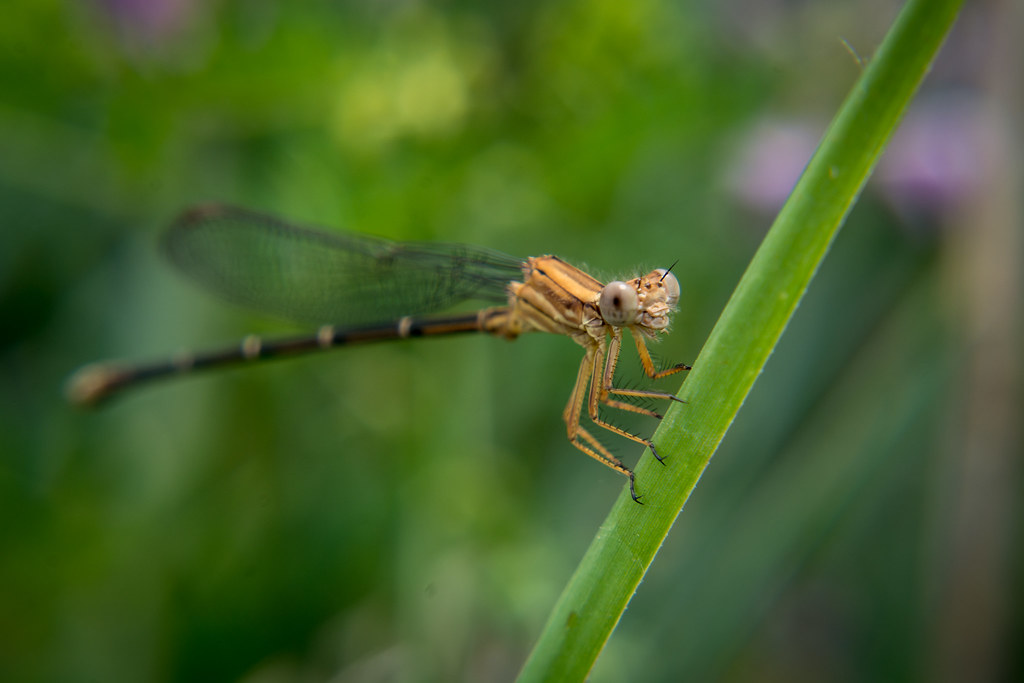
After a little while Phil pointed out the dragonfly you see in this week’s image, and after taking some pictures he stepped aside and I eagerly moved in to see what I could get. I was using my +10 filter which meant I had to be about three inches away, but this gold-colored dragonfly didn’t really seem to mind too much. In fact I don’t think he minded anything at all, judging by the look on his face :) I shot this at f/8, ISO 160, 1/180 second which was more than fast enough given that the insect wasn’t moving at all, and much smaller than f/8 would have given me a depth of field that was simply too shallow. As you can probably tell by the slate of recent pics here on Weekly Fifty I’m really enjoying these close-up filters, and if you don’t have some yet I’d highly recommend getting a set. They’re very cheap and can introduce you to a whole new world of photographic possibilities!
Read my educational photography articles at Digital Photography School

Transition

July 27, 2016 12 Comments

Beforehttps://www.weeklyfifty.com/wp-content/uploads/2016/07/WeeklyFifty2016July27Transition.mp3

This photo came about somewhat by accident, and not really how I intended, but led to a series of images of which I am rather fond nonetheless. I have posted some pictures over the years involving magnolia trees, which are quite prevalent here in this part of Oklahoma, and the beauty of their flowers never stops being amazing to me. I hope, then, that you won’t mind yet another photo (or two or three) of the same subject :)

When I shot this picture I was on a short walk and wasn’t really looking for an image quite like what you see, but I did know I wanted to capture a magnolia flower somehow using my D7100 and a close-up filter. (I think might have been either a +4 or a +10 but can’t remember which.) Not 30 seconds into the walk I came across this flower which was just starting to emerge, and as I took a few shots I specifically framed the subject so it was being blocked a bit on the left-hand side by one of its own massive petals. I wanted to create a scene almost as if the viewer is peeking in on the beginning of something fascinating not unlike when a baby raptor emerges from its egg in the original Jurassic Park. Though hopefully this flower is much more benign.

I thought the image was decent but kept on looking around for something…different. On another tree I spotted this flower which was much farther along in its progression:

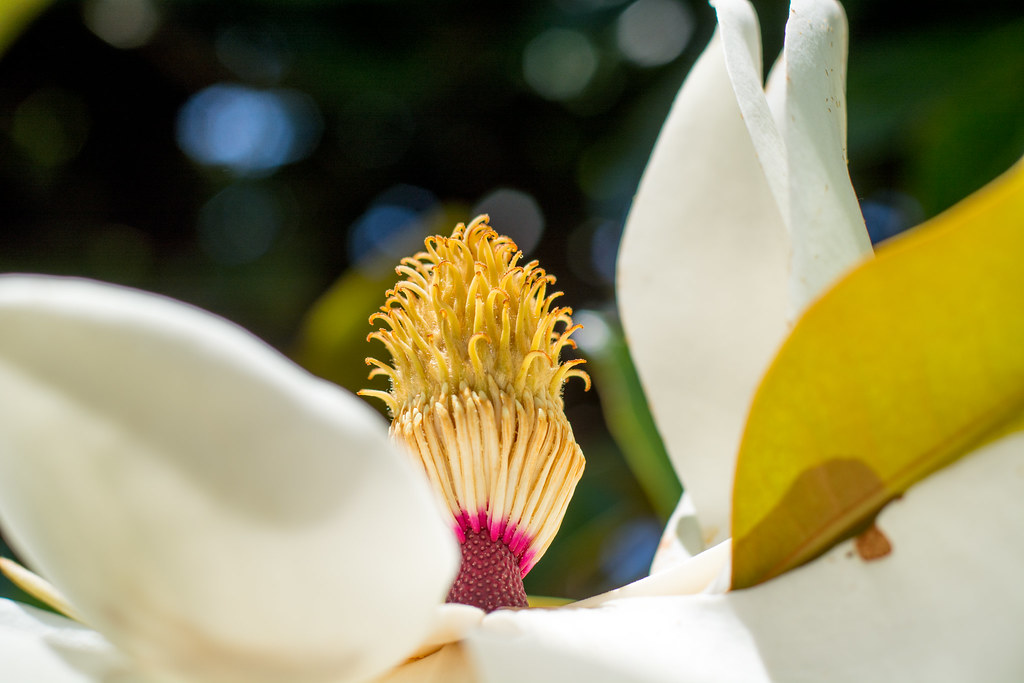
DuringFor this image I removed the filter so I could get a little more context for the flower. I wanted to see some of the petals and surrounding scenery which wasn’t really possible with a close-up filter attached. I shot from a low angle because I thought it would be more appropriate to see this flower reaching, stretching, lifting high into the sky like Andy Dufresne at the end of Shawshank. (Though ironically, that scene was shot from above in kind of the opposite fashion. Hmm. Perhaps I need to re-think my technique.) It made no sense to use a filter on the second image because it would have severely restricted my field of view and given the viewer no sense of context at all, and I liked the idea of showing the petals opening wide as the ball of pistils raised the anthers high almost like a chorus of worshippers praising God on a Sunday morning. In his gospel Luke recounts a scene in which Jesus tells the religious leaders of the day that if his disciples are not allowed to speak, the rocks and stones around them will cry out with praises to the Lord. I don’t know if they had magnolia trees in Israel back then, but it sure looks to me like that’s what is happening here in this picture :)

As I rounded the tree I came upon one final scene that shows the progression of a magnolia flower, and even though the beauty and glory has faded there is still much to be seen.

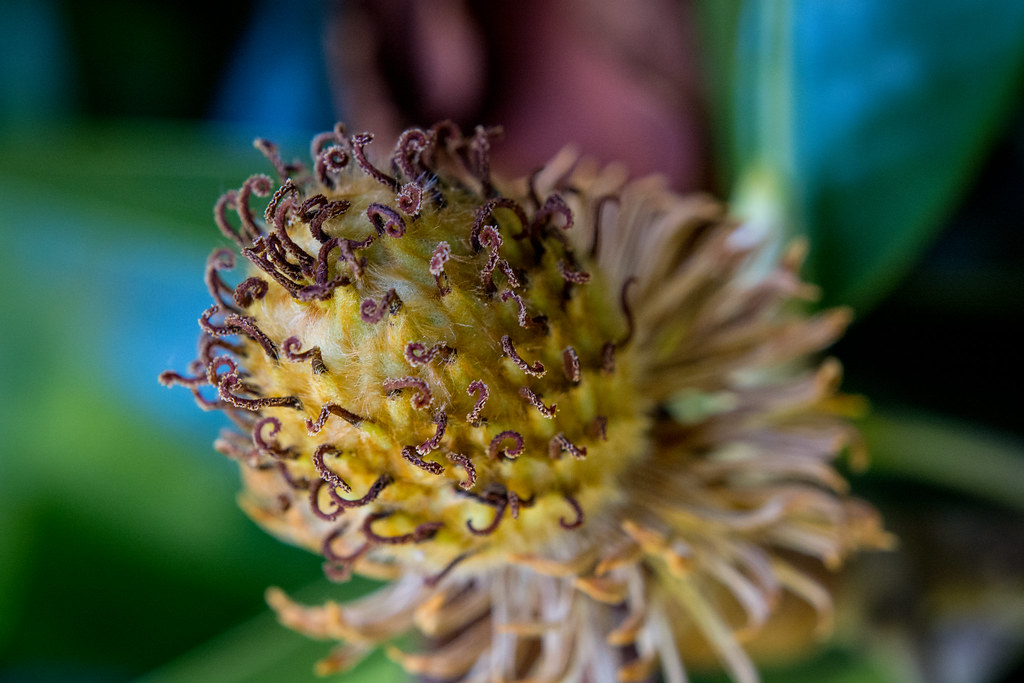
AfterThe anthers are withered, the pistils are faltering, and yet despite the impending sense of loss and decay there is hope to be found here as the flower has served its purpose, and in its death there lives hope: inside the ball of pistils are dozens of bright red seeds only beginning to take form, and in a few months what was once a flower will be transformed into a thick green shell which will house them until they are fully mature. After that the shell itself will wither and die, exposing the seeds which may take root and turn into majestic trees of their own someday.

I wasn’t expecting to capture all this on a single 10-minute walk one warm May afternoon, but that’s the nice thing about photography. You never know what you’re gonna get.

Read my educational photography articles at Digital Photography School

Earnest

July 20, 2016 12 Comments

Earnesthttps://www.weeklyfifty.com/wp-content/uploads/2016/05/WeeklyFifty2016July20Earnest.mp3

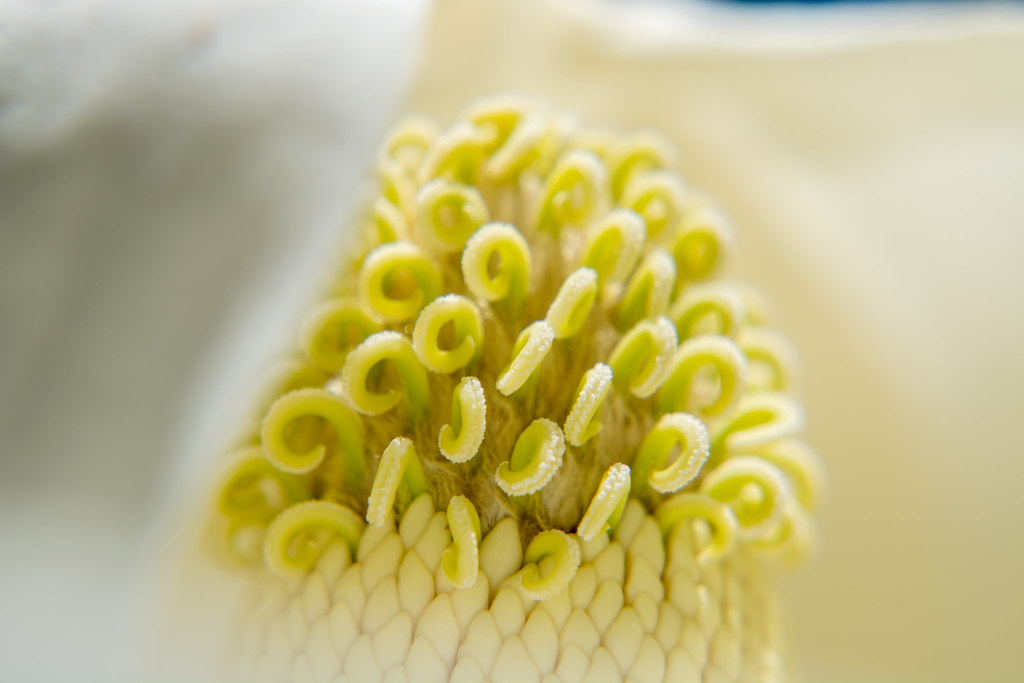
Alright, here you have it. This photo right here…this is the reason I bought a set of close-up filters. Every time I have seen a shot like this over the past several years I have wanted to get one of my own, but never had the proper equipment to make it happen. Certainly any one of my cameras could get this shot, even my old D200, but there’s no way to get a picture like this without using some type of macro equipment. The subject is just too small, and taking a picture with a normal lens and cropping it in post does not at all yield the same results as simply getting very close to the subject. However after getting my close-up filters and trying a few experiments I knew a shot like this was possible, which then meant I had to find a way to make it actually happen.

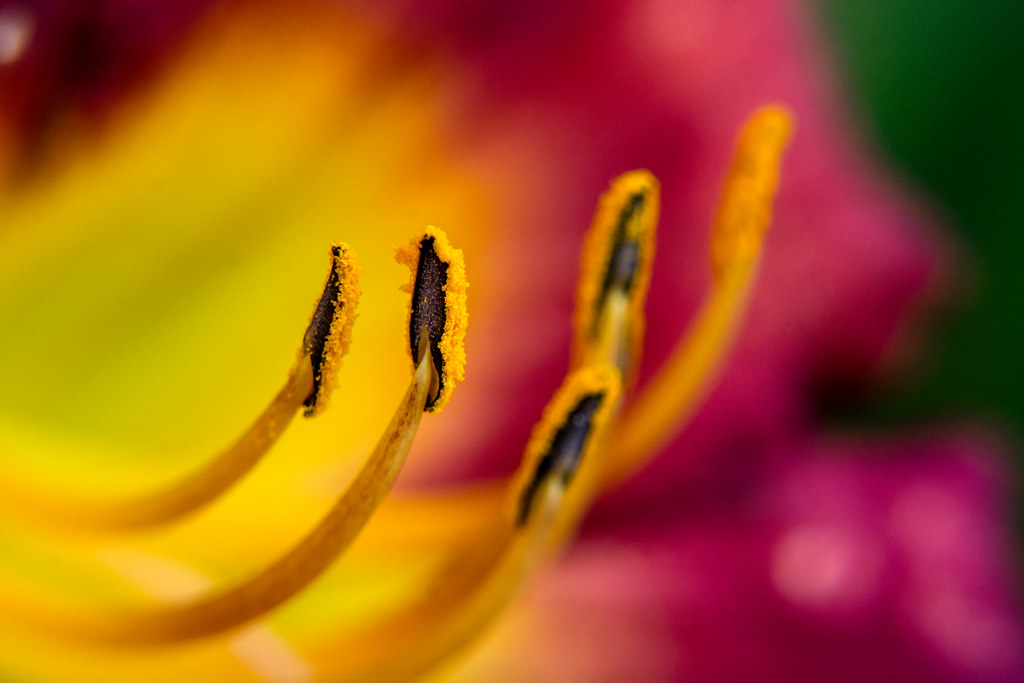
What you are seeing here are the anthers at the end of the filaments on a flower. (It’s some kind of lily, I think, though I’m not certain.) I found this, as I do so many of my Weekly Fifty pictures, on the campus of Oklahoma State University as I was out running an errand one day in late May. I figured we must have had some flowers on campus that would allow for this type of image but for a few weeks I had been mostly unsuccessful in locating any, until I cam across this one near the south side of our student union. There was a bit of a breeze so it made focusing a little tricky, and I ended up mostly just moving myself forward and backward as I snapped the shutter in order to get the picture I was hoping for. Even at f/8 I knew the depth of field would be so shallow as to be almost uncontrollable, and autofocus wasn’t helping much because of the way close-up filters degrade its accuracy along with the light wind causing its own set of problems.

I kept at it though, and after shooting the flower from one side I scooted over and tried a different angle while finally resulted in the image you see here. I hope I’m not being conceited when I say how pleased I am with the picture and the way it turned out–it’s not often that an image comes across exactly how I picture it in my mind, but that’s precisely what happened in this particular instance. I like the clear, distinct color palette and the sharpness of the foremost anther, and I like how you can clearly see a context for the subject too. Going much wider on the aperture would have resulted in a depth of field that would have likely obscured too many background elements and made it well-nigh impossible to get the one single anther in focus anyway.

I’m excited to keep using these filters and maybe one day get my hands on a true macro lens to play with too. It sure would be fun :)

Read my educational photography articles at Digital Photography School

Leaf-Footed Tree Bug

July 13, 2016 6 Comments

Mesquitehttps://www.weeklyfifty.com/wp-content/uploads/2016/05/WeeklyFifty2016July13LeafFootedTreeBug.mp3

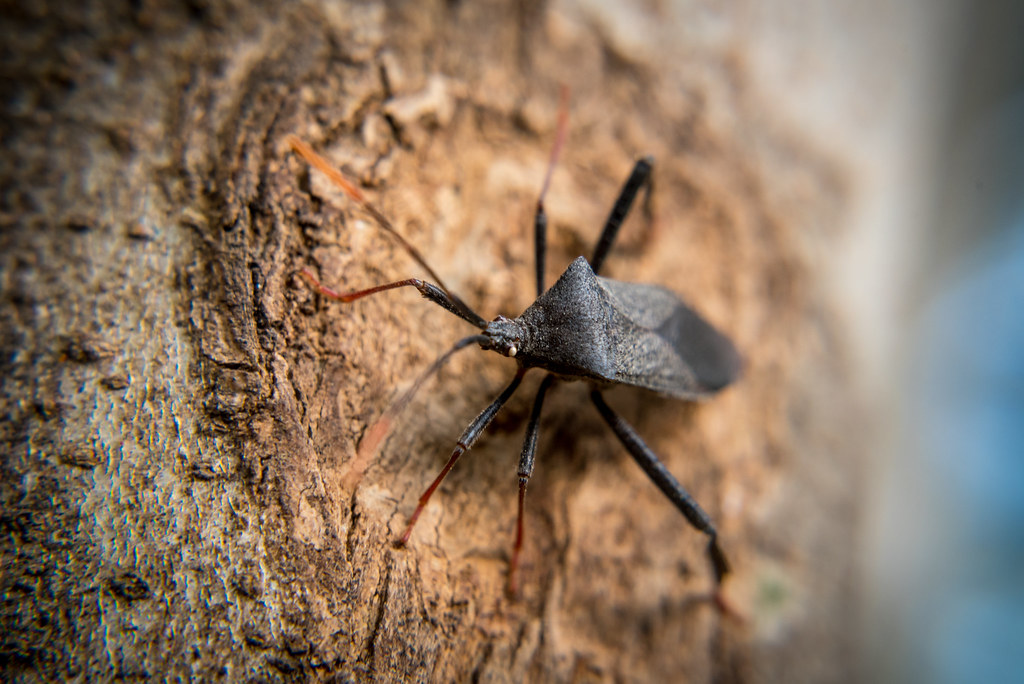
Here we have what I believe to be a giant mesquite bug, though I would gladly welcome corrections from any eagle-eyed entomologists who happen to be reading today’s post. a leaf-footed tree bug (acanthocephala terminalis), which I was able to identify with the help of some very nice strangers on Facebook :) This is another result of my continual experiments with close-up filters (see last week’s post for more details) and the more I use these little lens attachments the more I like them. And, the more I can hardly believe the results I am getting for such a cheap price.

One thing that has always fascinated me about macro photography is its ability to capture bugs and insects with incredible detail–often of the sort that is hidden from normal human eyes. It is something I have tried from time to time with my lenses but thanks to a rather weak maximum magnification it has mostly eluded me. Even with the close-up filters I am still having a lot of trouble because they require you to be very close to your subject–a situation that a telephoto macro lens like Nikon’s 105mm f/2.8 beast would be able to handle much better simply because it could be positioned farther away and focus across a much wider range as opposed to only being able to focus up close. However when I was playing with my kids in the backyard recently we came across several of these bugs crawling on a fence and since they don’t generally move all that quickly I thought it would be an ideal situation for playing around with some close-up shots.

At the time I did not have my camera with me but after dinner the three of us went back out and, with our glimpses peeled, soon spotted the small herd of six-legged friends which had by then migrated from the fence to a tree. We spent about ten or fifteen minutes moving in and around the tree, the boys looking for bugs while daddy rushed in to get some pictures, and soon discovered that while these insects don’t move very fast they do have a tendency to fly away at inconvenient times such as when a big ol’ Nikon DSLR is hovering about an inch and a half away. Out of 17 shots this was the only one that turned out, and even this one isn’t as good as it could be because the eyes of the bug are just barely out of focus. If you click on the image and look at the high-rez version on Flickr you will see that the in-focus area, or depth of field, is just behind the head and not actually on the head itself.

A couple problems cause this sort of thing to happen:

• When dealing with close-up photography you have a super duper shallow depth of field even at smaller apertures. The depth of field here is less than 1/4 inch and I was shooting at f/8.

• When shooting with close-up filters the autofocus doesn’t work too well, and even when it does the image often comes out a bit soft.

• I have learned that for close-up shots like this one it’s best to focus manually (yay for back-button focus!) which, combined with a moving subject and jittery photographer, make nailing focus even more tricky.

Still, overall I am very pleased with this shot and continue to be blown away at how effective these close-up filters are. I shot this with a +10 and +2 combined together, and even with all that extra glass jammed on front of my lens I am amazed at how sharp the final images can be. Is it as good as a dedicated macro lens? Not at all. But it’s also way cheaper, which goes a long way with me :)

Read my educational photography articles at Digital Photography School

Fossil

July 6, 2016 12 Comments

Fossilhttps://www.weeklyfifty.com/wp-content/uploads/2016/05/WeeklyFifty2016July6Fossil.mp3

This week’s photo is a bit different from most of the pictures I have posted here on Weekly Fifty over the years. It’s the result of some experimenting I have been doing lately with a set of close-up filters. These, to be precise. Ever since my cousin Beth got an Olloclip which basically turned her iPhone into a macro photography machine I have wanted a similar solution for my DSLR. Unfortunately, actual macro lenses range in price from “Impractical” to “Not a chance” for most hobbyist photographers like myself, so until recently I basically found myself left out of the close-up photography party altogether. I had investigated various solutions like extension tubes and lens reversing rings, but they all seemed kind of expensive and more than a bit impractical for someone who just wants to play around with macro-style photography on occasion. I had heard of close-up filters before but never given them much thought until I realized that, for just about the cost of a pizza or two I could at least get something that would let me try this type of photography. If it worked, great! If not, no big deal. So I bought a set and kept my expectations low.

My goodness, were they ever exceeded. By a very long shot.

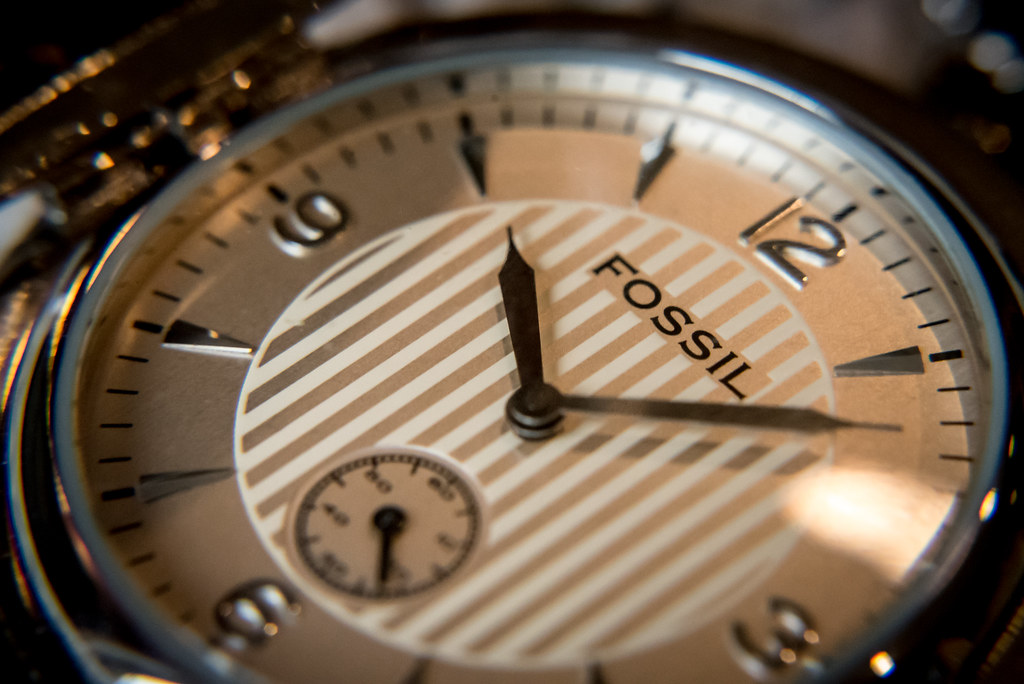
I explain more about what close-up filters do and how they work in an article I recently published on Digital Photography School, but the gist of it is they let you use any regular lens to focus on things that are super close. Super duper close, to be honest. The pocket watch you see above is about the size of a silver dollar in real life, but it filled the entire frame of the picture thanks to a +10 filter that I attached to my 50mm lens. It’s kind of unreal how well these little screw-on filters work for taking non-professional good-enough macro shots, and after using them for a while now I can confidently recommend them to anyone who is looking for something new and fun to try.*

On a side note, this watch was the one I wore when my wife and I got married just over ten years ago which is one reason I’m using it as this week’s picture. It’s sort of a commemoration, if you will. My three brothers served as my groomsmen and we all had identical pocket watches, and even though I don’t exactly wear mine on a regular basis I like to take it out from time and reflect on that special day. Of course I have plenty of other tangible reminders of my wedding day around me constantly, but it’s fun to get out special objects, totems, and trinkets like this from time to time (har!) as they help conjure up fond moments from days gone by in a unique way. It sure has been an incredible decade, and if my wife is reading this, I love you and our two little boys so very much. Thank you for being my beautiful bride, and here’s to many many more years of being your hubsand :)

*If you do want to purchase some filters, make sure they fit your lens. Check the thread diameter on your lens first, which will likely be something like 52mm or 58mm, and then get filters that will fit that size.

Read my educational photography articles at Digital Photography School

  • « Go to Previous Page
  • Page 1
  • Interim pages omitted …
  • Page 100
  • Page 101
  • Page 102
  • Page 103
  • Page 104
  • Interim pages omitted …
  • Page 138
  • Go to Next Page »

Copyright © 2026 Creative Commons License
This work is licensed under a Creative Commons Attribution-NonCommercial-NoDerivs 3.0 Unported License.