• Skip to main content

Weekly Fifty

Exploring the wonders of creation through a 50mm lens...and other lenses too.

  • Subscribe
  • YouTube
  • About

Bright Spot

August 7, 2019 Leave a Comment

FUJI6964.jpg

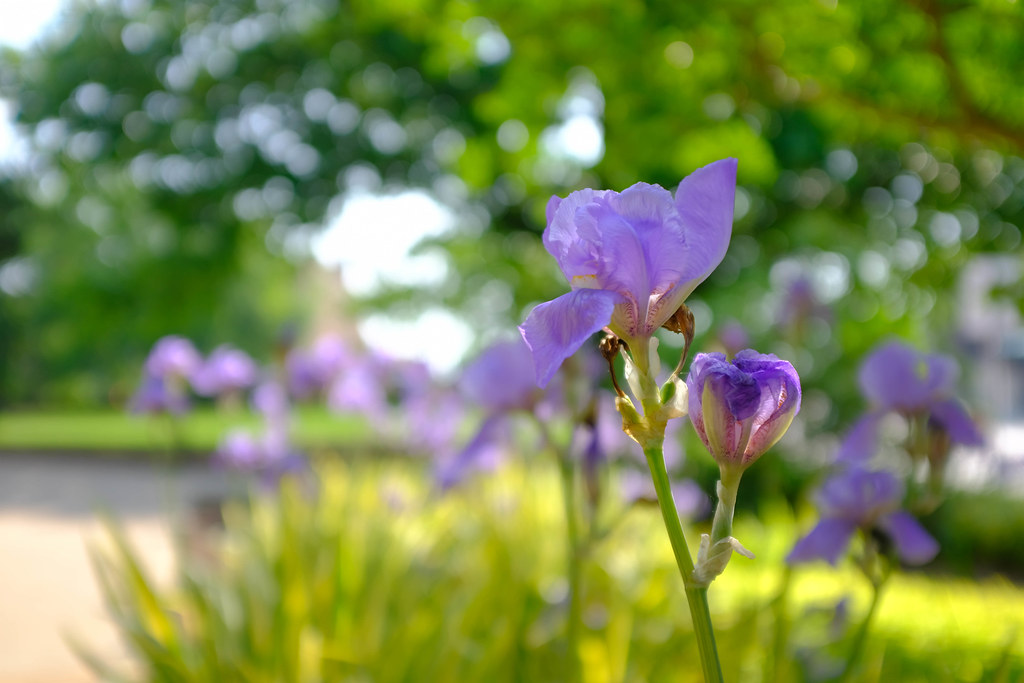
It’s been a rough couple of months here in the Midwest, and hopefully by the time you read this the sun will be shining and the waters will have receded a bit! We capped a chilly winter with a very wet and rainy spring that saw rivers well over their banks, lakes swelling, and farmland inundated with more water than it could handle. The day after I took this image we got yet another all-night downpour and Theta Pond, which was right behind me as I shot the picture, was more like Theta Reservoir and a little waterfall was pouring onto University Avenue because of it. And thus the name of the picture reflects the conditions in which it was shot, which was an abnormally sunny day in the midst of lots of cloudy ones.

My inspiration for this photo was a few images that I recently posted which I took with my niece when she was in town. It’s weird how the simple act of going out to take photos of flowers can be so soothing, and a good way to slow down and enjoy the simple things in life. There’s flowers all around, especially at this time of year, and yet how many times have I thought to myself “There’s nothing to take pictures of?” (Answer: way too many times.) So I figured I would do just that, and it was a nice way to slow down for a bit which also resulted in a cool photo.

As is normal for me when I use my X100F I shot this in JPEG and used the Velvia film simulation so I wouldn’t have to do a lot of RAW editing. I shot wide open at f/2.0 to get a bit of foreground/background separation, and I think (though I’m not exactly sure) I used the electronic shutter so I could get a proper exposure despite shooting wide open. I used to activate the ND filter for situations like this, but that often slowed down the focusing so I’ve been using the electronic shutter instead and for the most part it works quite well, especially outdoors.

Read my educational photography articles at Digital Photography School

Zoo Therapy

July 31, 2019 Leave a Comment

FUJI6969.jpg

Each semester during dead week (aka the week right before final exams) OSU hosts a petting zoo for the college kids on campus. And I know what you’re probably thinking…a petting zoo for college students? That sound so stupid! But I’m telling you, it’s not. Every time this petting zoo shows up I’m amazed at how many students surround the animals, interacting with them and spending a few minutes getting lost in the moment before heading back to their studies and other obligations. And not just students, but staff and faculty members too. It might seem silly but a handful of barnyard animals can do wonders for people of all stripes and walks of life during an intense and often stressful part of the year.

When I visited the Finals Week Petting Zoo during May of 2019 I was on my way to a faculty meeting but stopped long enough to get a few pictures. I would have loved to stick around for a while just petting the goats and rabbits (and one llama, I think) but, as they say, it was not meant to be. Still, the few minutes I did have were pretty relaxing and I tried to get a few shots of the occasion as well. The X100F is perfect for this type of scenario since the 35mm (equivalent) focal length lets you isolate a subject while also showing plenty of surrounding context, which is what you see here. The sheep is clearly the subject of this image while behind it you can see students, a building, trees, and more. I shot this wide open at f/2.0 to get some background blur, which incidentally meant I had to use the electronic shutter since the mechanical shutter on the X100F has a max speed of 1/1000 second at f/2.0, but a proper exposure required 1/2000 second.

One thing you’ll notice about this photo is the colors look a bit…odd. Over-saturated, perhaps. I shot this in JPEG using the Velvia preset and I’m not entirely happy with how it turned out. It’s a little overdone for my taste, but rather than shoot and tweak in RAW I’m finding that I prefer to customize my JPG settings and just let the final picture be what it is. So this was definitely a learning experience for me, and it will continue to be so as I play around with the JPG settings.

Read my educational photography articles at Digital Photography School

May Day Mushroom

July 24, 2019 Leave a Comment

FUJI6926.jpg

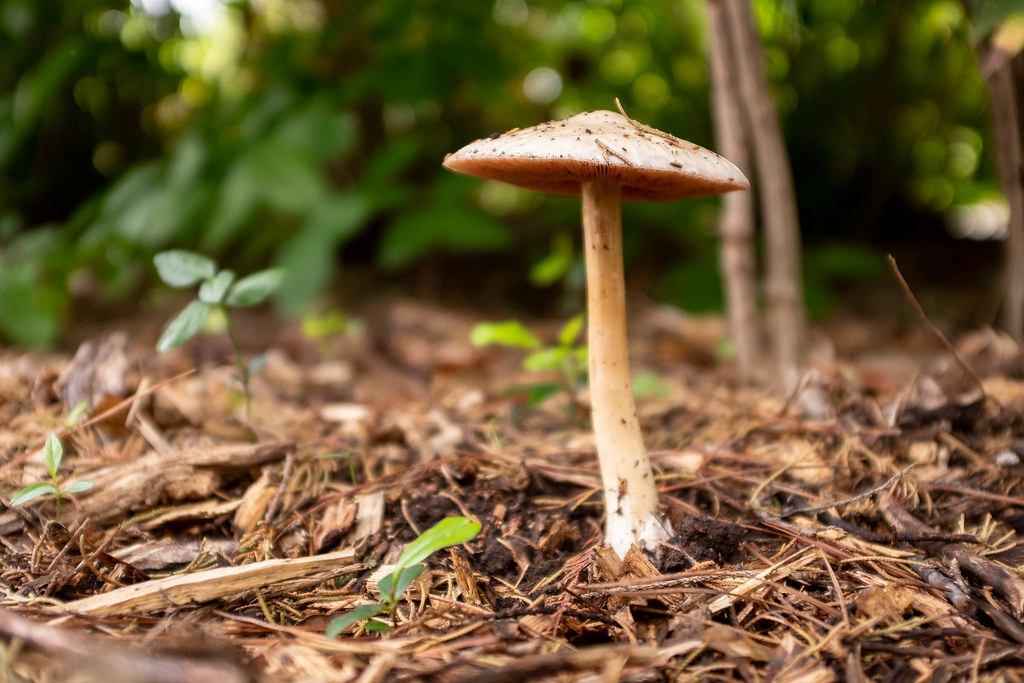
I’m not sure why, but I kind of have a fascination with photographing mushrooms. They’re not around for long, and when you get down low to the ground to take a picture it feels a bit like you’re sneaking a peek into some kind of hidden kingdom. You don’t see them out in the open very often, and something about the conditions in which you often find them (i.e. musty, damp, kind of dark) just seem kind of…different. When my wife and I took our kids to the local botanic garden for their annual May Day event we were about to head to one of the art pavilions when I spotted this mushroom poking through some mulch near the base of a tree, so I told them to go on without me for just a minute.

I had (what else?) my Fuji X100F with me which isn’t super sharp at maximum aperture when photographing subjects up close, but in this case I cared more about blurring the background than getting an ultra-sharp image, so I didn’t care too much about the technical details and just went all the way to f/2.0. I shot this in JPEG, as I usually do with my Fuji, and used the Velvia film simulation which is really well-suited for nature photography because it has a rich but not overly-saturated color palette. I positioned the mushroom slightly off-center to get some greenery behind it, and even though there’s some weird smudging along the left side of the stem I’m really happy with how it turned out. It’s got a nice sense of time and place, and the overcast sky lent a nice even lighting to the whole scene.

I think one of the things that draws me to these types of pictures is the transient nature of the subject. If I would have come back to the same spot the next day, the mushroom would have been gone. These things come and go so quickly you really don’t have much time to photograph them, which means you get a nice little slice of time captured on camera that’s somehow different from a lot of other pictures.

Read my educational photography articles at Digital Photography School

All Things New

July 17, 2019 4 Comments

DSC_5310.jpg

You probably know by now that I’m no arborist, and my knowledge of plants and vegetation is about the same as my knowledge of particle physics. Which is to say, not exactly stellar. All I know is that flowers can be really pretty, and when I see interesting shapes and colors in nature I like to have the opportunity to capture them with my camera. About a week before I took this shot last April I noticed trees all over town exploding with bright purple flowers and while the effect was fascinating to see, I was never able to really get the kind of picture I wanted. Everything I tried just wasn’t quite able to capture the image I had in my mind, until I took a closer look and found what I was missing.

The key to getting the picture, I realized, was to give the viewer something to focus on. With an entire branch full of purple and pink there was no one clear spot to look at, but after realizing that many of the trees also had tiny little leaves sprouting from amidst the puffs of violet I knew I could use that to my advantage. I used my Nikon D750, 50mm lens, and a +4 close-up filter to get close to the leaves, and shot at f/5.6 to get a reasonably wide depth of field. This let me get the leaves to be sharp and focused while still giving me plenty of background blur, which hopefully helps the viewer see that there’s a lot more going on than just some leaves.

This is another example of the continuous learning process that is basically required of anyone who wants to learn more about photography. Or any given pursuit, for that matter. I had the equipment to take this picture about three years ago but none of the knowledge and experience, either on a technical level or from an artistic standpoint. It’s fun to see what happens as you refine and hone your craft over time, and I’m sure not too long from now I’ll revisit a scene like this and take a picture that’s even better. And it’s this cycle of continuous learning and improvement which makes this hobby so much fun :)

Read my educational photography articles at Digital Photography School

Stalwart

July 10, 2019 2 Comments

DSC_5723.jpg

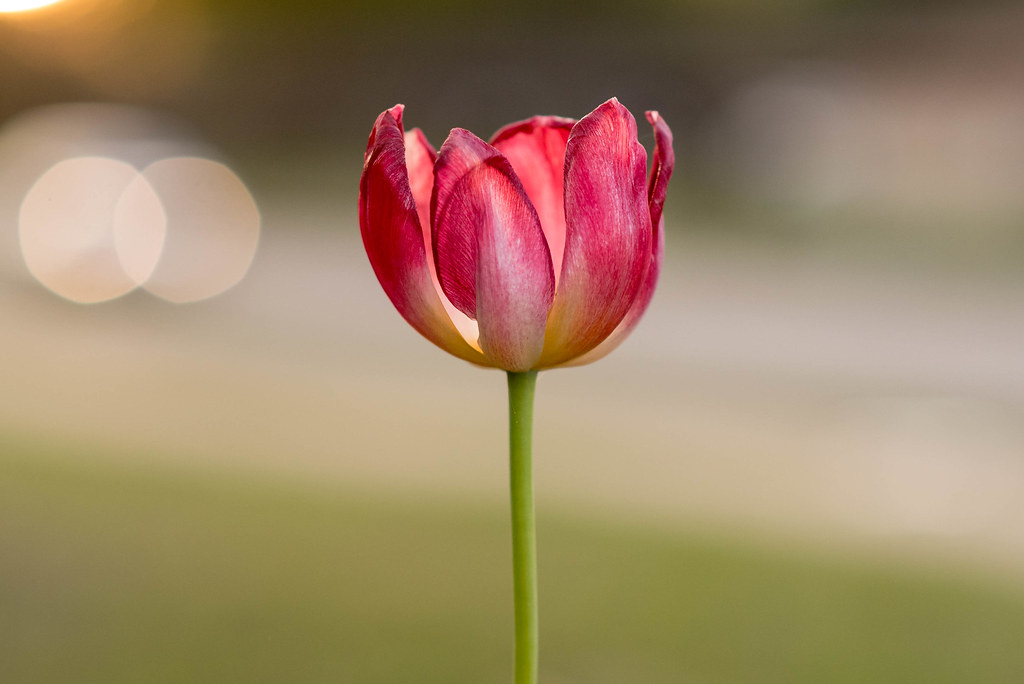
In last week’s post I wrote about how the flower photo which was showcased came about as a result of a short drive down the street with my niece to experiment with, and learn more about, photography. This picture also came from the same event, and it’s also an illustration of how sometimes people can see things that you might not notice even though they are right in front of you.

After my niece and I spent about 20 minutes taking pictures of purple tulips we got in my car and drove down the road a little ways to see if there might be any other scenes worth photographing. The sun was rapidly descending on the horizon and after going about a half mile and coming up empty I turned around in a parking lot and we headed for home. That’s when she spotted this lone tulip poking up in the middle of a boulevard, all by itself, and excitedly told me to pull over so we could get a shot. I didn’t even realize this flower but she had no trouble spotting it, so I found a safe spot to park and we ran over to see if we could get any pictures before we lost all the light we had.

As we looked at the scene from different angles and played around with different apertures (She had my Nikon D7100 + 50mm lens, I had my D750 + 85mm lens) I noticed something that we could use to our advantage despite the quickly-dimming sunlight: headlights from passing cars. I showed her how, by getting close to the flower and shooting wide open, she could transform headlights into big blurry balls of orange and yellow. You can see the effect in the photo above, which is quite pronounced even when shooting at f/2.8 instead of f/1.8, and it was neat seeing her eyes light up when she realized that these effects were a result of controlling her camera, not adding a filter on her camera. Not that there’s anything wrong with the latter method, but sometimes it’s just kind of neat to learn that you can do it yourself :)

Read my educational photography articles at Digital Photography School

  • « Go to Previous Page
  • Page 1
  • Interim pages omitted …
  • Page 69
  • Page 70
  • Page 71
  • Page 72
  • Page 73
  • Interim pages omitted …
  • Page 139
  • Go to Next Page »

Copyright © 2026 Creative Commons License
This work is licensed under a Creative Commons Attribution-NonCommercial-NoDerivs 3.0 Unported License.