• Skip to main content

Weekly Fifty

Exploring the wonders of creation through a 50mm lens...and other lenses too.

  • Subscribe
  • YouTube
  • About

Simon

Turtle

July 12, 2017 3 Comments

Turtlehttps://www.weeklyfifty.com/wp-content/uploads/2017/05/WeeklyFifty-2017-July-12-Turtle.mp3

I think the universe is trying to tell me something here.

After last week’s post regarding the shooting of wildlife pictures with a 50mm lens, here we are once again with yet another animal captured on (digital) film with naught but a 50mm lens stuck to a crop-sensor camera. A simple but effective setup, to be sure, and one whose capabilities continue to surprise me even though it’s something I shoot with almost every day. Note to Ryan, once again: You did indeed tell me so :)

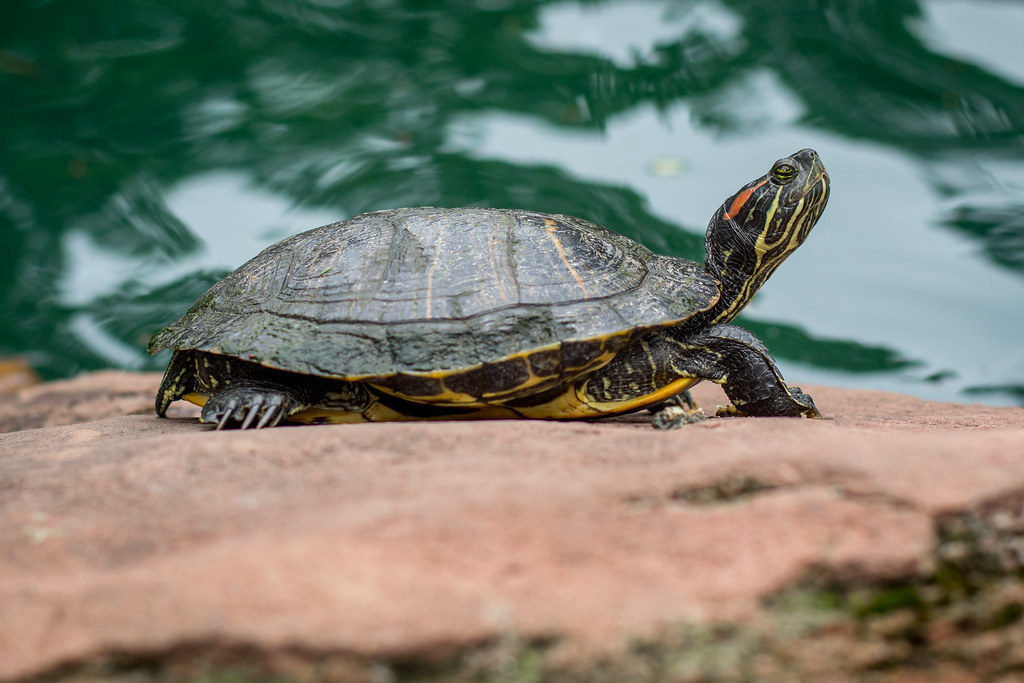
As I often do, I was out for a short walk around Theta Pond one day this Spring after school had let out for the summer, and was a bit surprised to see a cluster of turtles sunning themselves on a rock. Seeing just a single turtle isn’t a big deal over at Theta Pond, but four or five together doesn’t happen all that often, so I walked over to get a picture…and they all slid right into the pond in the blink of an eye. Major bummer.

A few yards away there was another rock with some more turtles on it, so I changed tactics and, using the patience I often talk about here on Weekly Fifty but continually forget to have when it really matters, I veeeeery slooooly crept towards the group of amphibians while warily wielding my camera. I moved a few inches at a time and looked not at the turtles but out towards the pond, and much to my dismay they began to disperse one by one until there were just two left. And then soon after that just one.

Nevertheless I continued my slow walk over to the rock, which at this point was almost a crawl, and started snapping pictures of the lone turtle that remained. I fired off five or six shots, then crept closer, and got a couple more. And then more, and then more, until I was probably just a few feet away at which point I frantically began changing from f/1.8 to f/2.8 and even f/4 in order to make sure I got at least one good shot. I kept the focus locked on his eye and used the motor drive to get several dozen shots, hoping I would walk away with something I liked. After a minute of this I got up, said “Thank you for letting me take your picture,” and turned to walk back to my office.

Later on as I was going through the photos I saw that most of them were in focus and tack sharp, which meant I could then shift my attention to the background in order to find one I really liked. I found several where the turtle’s face was pointed slightly away, or where it blended in too much with the water behind it, but eventually found the image you see here where everything seemed to come together really nicely. The turtle’s face is silhouetted against a patch of sky reflected in the water, and the shimmering reflections of light coming through a grove of cypress trees made the darker portions of the water almost seem to sparkle. Depth of field here is just a tad shallow as the foreground of the shell is slightly blurry, but this was shot at f/2.8 and when I stopped down to f/4 I realized the benefits in foreground detail meant a tradeoff in background blur that I didn’t like.

Though turtles are often depicted as slow and ambling, I have often been surprised at just how quickly they can move if the need arises. It was because of this that I was so pleased to get this photo and it has once again shown me that a 50mm lens works just fine for wildlife photography, provided you use a bit of patience, planning, and a bit of preparation so you know how to get the shots you are going for.
Read my educational photography articles at Digital Photography School

Turtledove

July 5, 2017 8 Comments

Turtledovehttps://www.weeklyfifty.com/wp-content/uploads/2017/05/WeeklyFifty-2017-July-5-Turtledove.mp3

Several years ago when I first got started getting serious about photography, my buddies Ryan and Kevin convinced me to forego a kit lens and instead purchase a 50mm lens. That decision was directly responsible for lighting a fire beneath my feet, photographically speaking, and immediately opened my eyes to the vast world in front of me that I was suddenly able to capture in my camera how I saw it in my mind. I always wanted to experiment with shooting in low light, isolating my subject, getting tack-sharp portraits, and of course get those oh-so-blurry backgrounds but until I got that Nifty Fifty I thought some kind of secret alchemy was required that only True Photographers possessed. Turns out all you need is a 50mm lens*

The more I used my D200 + 50mm lens, the more excited I got at the possibilities it offered to me as a photographer. However, one thing continued to confound me and not too long after I got started with photography I, somewhat infamously, told Ryan that a 50mm lens is ill-suited for wildlife photography. In fact I could have hardly been further from the truth, and Ryan told me as much at the time, but ever the over-eager newbie I, over the next few years, tried my  best to prove myself right. Thing is, I was wrong. The 50mm lens is great for wildlife photography, depending on the type of wildlife you want to photograph.

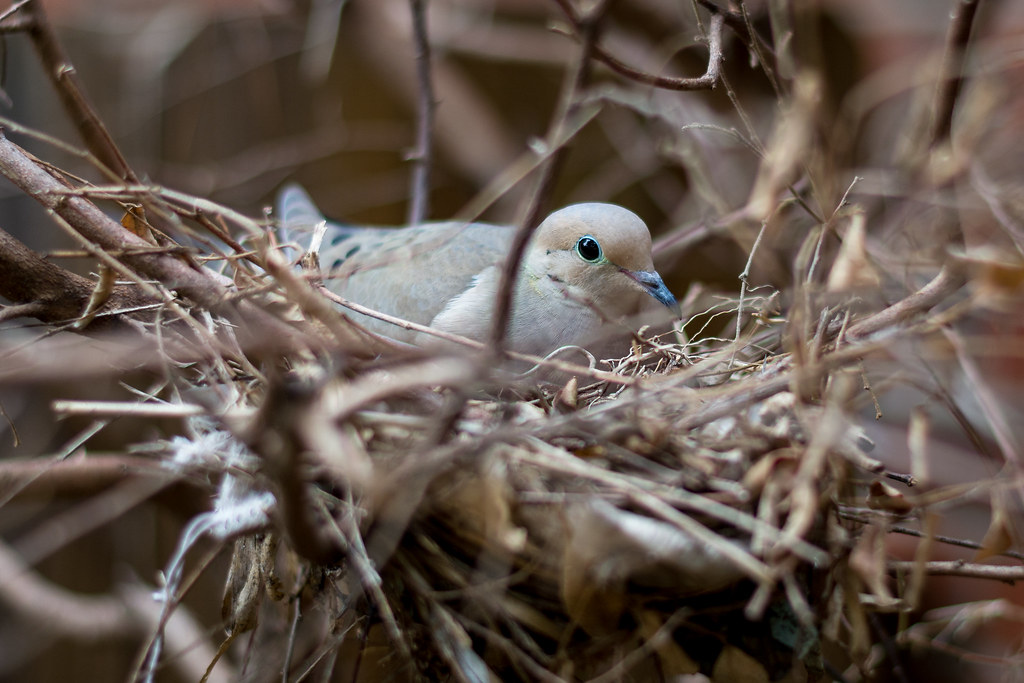
Case in point: today’s image of a turtledove peacefully resting in a nest. Could I have used a telephoto lens to get this shot? Sure, but that would have given me a more limited field of view compared to the comparatively wide angle afforded by a 50mm lens. All it took for me to get this image was patience and a bit of creativity, the limitations of a 50mm lens notwithstanding. Like so many photographic situations, it’s not the gear you have (or don’t have) but how you use it that matters, and a 50mm lens (or any lens, for that matter) can be perfectly suited to wildlife, landscape, sports, portrait, or any other type of photography so long as you are aware of its capabilities and limitations and allow yourself to work within that space.

Would a 50mm lens be ideal for getting close-up shots of lions while on safari? No, probably not. But could it capture lions on the horizon silhouetted against a sunset? Most definitely. Would a 50mm lens be ideal for getting tack-sharp images of a kingfisher diving for prey beneath the water? Not at all. But would it work to capture an intimate close-up of a turtledove sitting on her nest? Absolutely. This photo was taken right next to my house and the bird you see has gotten pretty used to a continual buzz of activity from my kids playing in the yard, which is probably why she didn’t mind when I climbed atop a stepstool just a few feet from her nest. She didn’t flinch much when I scooted closer…closer…closer with my camera while firing off a couple dozen shots. I even got down and moved the stepstool to reframe the shot, and she just sat quietly the whole time.

I guess my point is that this picture illustrates the same point I’ve been trying to make to myself for years here on Weekly Fifty: it’s important to know your limitations and then learn how to work within them to get the shots you want. Even if you don’t think the shots you want are possible, they probably are. It just might take a bit of patience and creativity :)

*ok…you don’t specifically need a 50mm lens since any lens will suffice. But read on to get the whole picture of what I’m trying to say.

Read my educational photography articles at Digital Photography School

The Early Flower

June 28, 2017 10 Comments

The Early Flowerhttps://www.weeklyfifty.com/wp-content/uploads/2017/05/WeeklyFifty-2017-June-28-Early-Flower.mp3

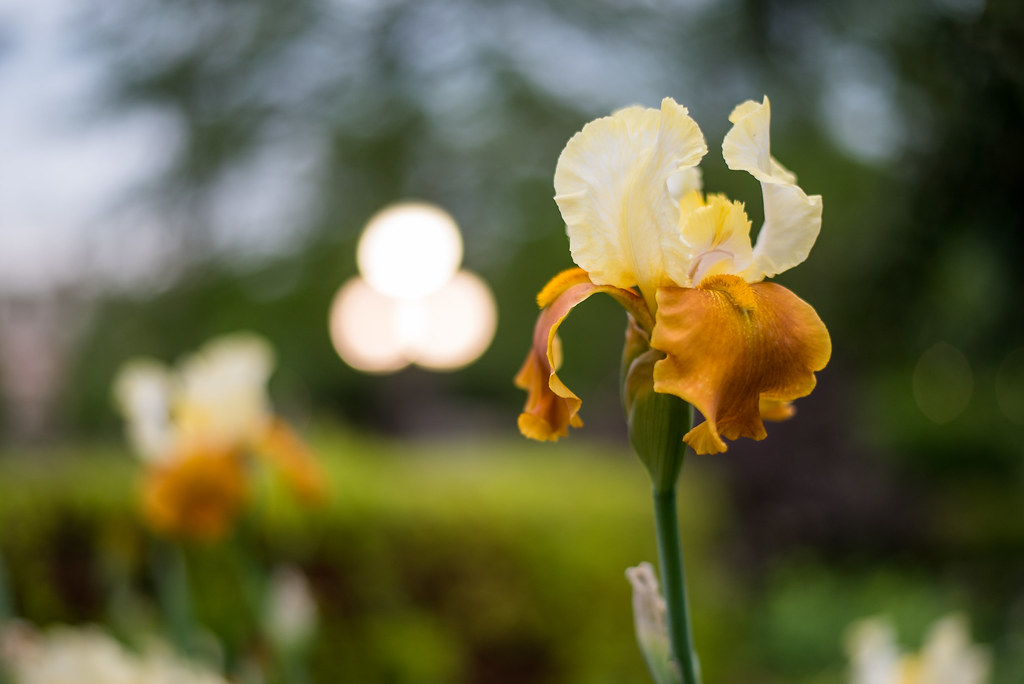
Taking this picture was kind of fun because I’ve realized that I don’t really take a lot like this anymore, which is kind of a shame. In truth I rather enjoy taking photos of flowers, but lately I’ve been mostly doing it with a close-up filter and thus missing out on some of the context and fun lighting that can come into play when composing a more normal view of something like this. As often happens with my Weekly Fifty photos I shot this early in the morning on my way to work, and with the sun just peeking over the horizon it meant a nice even diffused light covering the whole campus while also catching things at a time when the street lights were still glowing. And that’s where the fun part of this photo really came into play.

One thing I’ve learned when it comes to composing shots is that every element in the frame ought to be considered, from the foreground to the subject to the background and even other elements on the periphery that might not appear to matter. In this case there’s not much in the way of foreground elements, but I as I knelt down to take this picture I wanted to carefully pay attention to the background objects and compose my shot accordingly.

The subject is clearly the flower in front, but I also wanted to use another flower behind it as well as the triple-topped light post way in the distance as intentional elements of the shot. This required a bit of moving and maneuvering on my part while also taking my lens aperture into account. I shot a few images at f/2.8 and even a couple at f/4 but soon realized that while the subject was tack sharp in these, the background elements were not as blurred out as I wanted and thus the viewer’s eye was distracted and listless with no clear focal point. Thus I spun the dial on the front of my D750 clear to the left to get as wide of an aperture as possible, knowing full well that shooting at f/1.8 would mean an almost-too-shallow depth of field.

The results turned out pretty well, and though the yellow-orange petal closest to the viewer is a tad out of focus I’m glad that the rest of the flower is quite sharp. Ideally I think I would have physically separated the three elements of the shot (foreground flower, background flower, and light pole) with a bit more space instead of crowding things so close in the center of the frame, but overall I think the image is decent and a good reminder of why it’s fun to un-screw the close-up filters and just go take colorful pictures from a more normal point of view sometimes.

Read my educational photography articles at Digital Photography School

Gently Weeping

June 21, 2017 2 Comments

Gently Weepinghttps://www.weeklyfifty.com/wp-content/uploads/2017/05/WeeklyFifty-2017-June-21-Gently-Weeping.mp3

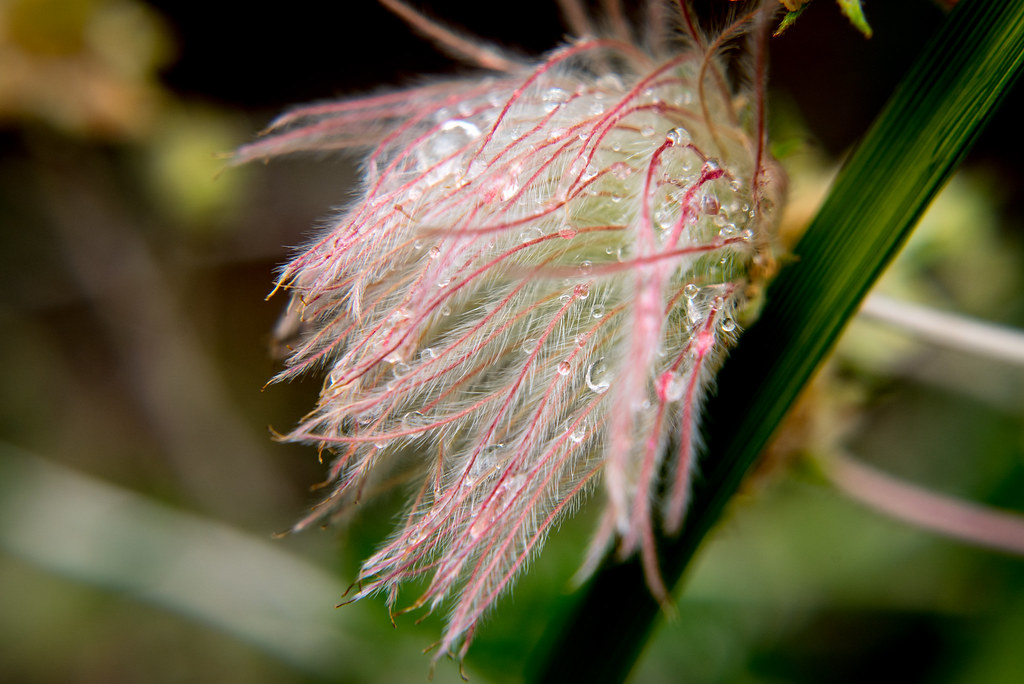
Taking this picture felt, in some ways, like the culmination of so many thing I have learned about photography over the years. From composing the shot to controlling the exposure to postprocessing…and even just seeing the photo opportunity in the first place, it all sort of coalesced into the picture you see here. I hope you don’t mind me saying that I quite like it and, at the risk of sounding a bit self-aggrandizing, I think it’s one of the better macro-style shots I have taken in a while.

So here’s kind of the play-by-play of how this shot came about. I was walking across campus one afternoon recently, following some light spring showers that had blanketed the city in a warm mist earlier in the day, and saw this tiny little…something. You all know by now that I’m no botanist and have little to no clue about what various plants actually are, but this thing was about the size of a quarter and I thought it looked so pretty, and delicate, with beads of water clinging to those fine white-and-red strands. Thankfully I had my D750, 50mm lens, and my usual set of close-up filters handy though I should let you know that I actually walked right on past this thing at first because I didn’t think it would really be worth photographing. I’m sure glad I was wrong.

I took one shot with my +4 filter and immediately realized I would need my +10, so I put that on and took a few shots at f/8. I didn’t bother with anything wider since I knew (after a lot of trial and error which has been well documented here on the blog) that f/8 would make sure much of the subject would be in focus while still getting a nice amount of background blur and also result in a sharper picture overall. The only real question was the angle at which I was shooting, and I moved my camera around a bit to get a couple of different viewpoints but in the end I only spent about two minutes on this shot before moving on, confident that I had something I would like.

Sure enough, when I loaded the images in Lightroom I found that I was perfectly pleased with most of them, so then it came down to a matter of personal preference. What ultimately did it for me on this particular shot was how sharp it turned out. If you click on the image and zoom in to 100% on Flickr you will notice that even the smallest wisps in the middle of the image are extraordinarily sharp, which doesn’t often happen when I do close-up shots like this. Of course there are plenty of strands that are not sharp due to the shallow depth of field (even at f/8) but right in the middle, where I hope the viewer’s eyes are drawn, is precisely what I was hoping it would be.

And so there you have it: a reason to keep practicing, trying new things, and taking pictures even when you don’t think you have anything around you worth photographing. Pause a moment and look at the world around you, and you just might find yourself in the presence of something beautiful.

Read my educational photography articles at Digital Photography School

Flying Aggies

June 14, 2017 6 Comments

Flying Aggieshttps://www.weeklyfifty.com/wp-content/uploads/2017/05/WeeklyFifty-2017-June-14-Flying-Aggies.mp3

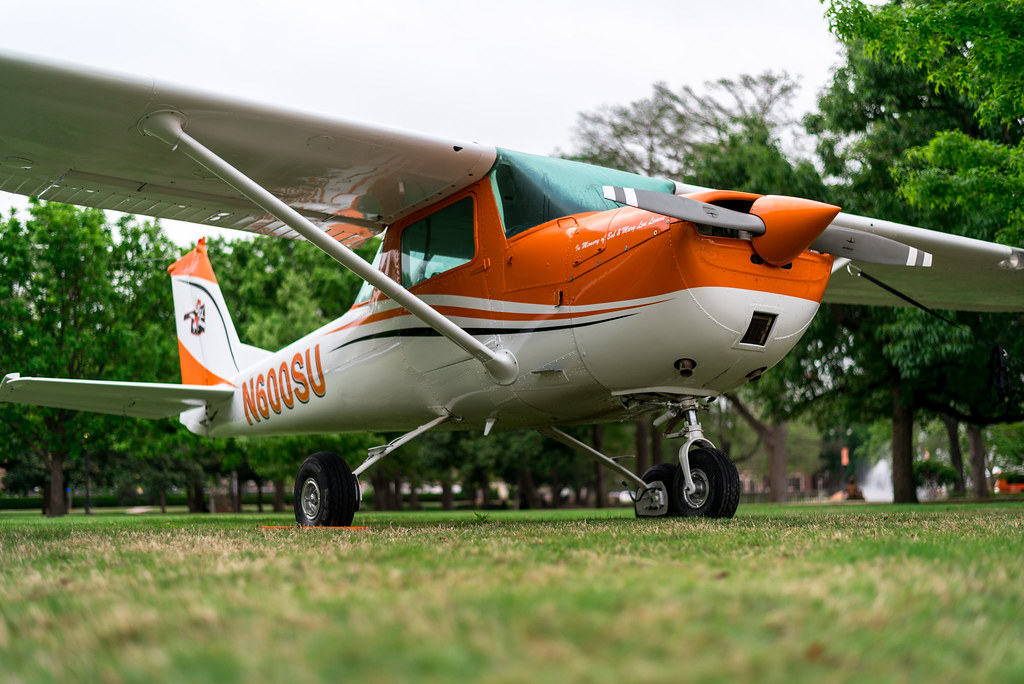
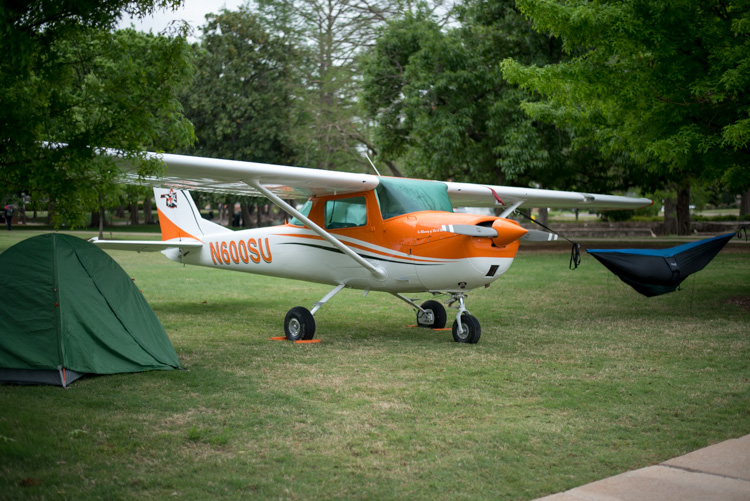
Sometimes I write about how unique and fascinating it can be to work on a college campus, and this shot is a good example of what I mean by that. There I was, walking to work on a drizzly Wednesday morning when lo and behold I came across an airplane sitting in the lawn just north of Theta Pond. (Look closely in the background and you can see one of its fountains.) At first I was a bit confused, and then when I noticed a tent on one side and a hammock on the other side, I was even more befuddled. Then I remembered that about this time in 2016 the OSU aviation students, otherwise known as the Flying Aggies, had parked the same plane at the same spot in order to spread the word about who they are and what they do.

I had a few minutes before I was supposed to be at work so I crossed Monroe, got out my D750 + 50mm lens, and took a few pictures. At first, like most people, I stood and shot from eye level and ended up with a couple images like this:

It’s not a bad shot and in some ways I kind of prefer it to the one I actually posted for this week because the trees and tents serve to create a somewhat unique and compelling story. Ultimately I decided that there was just too much going on in the frame, and with the colors of the tents being so similar to the surrounding scenery anyway I thought it would be best to just focus on the airplane. Basically, the one taken from eye level looked more like a snapshot whereas the one I decided to actually use felt more like an actual composition. I don’t know if I’m just grasping at straws here, and I might be, but I really do feel like there’s a substantive difference between the two.

I walked a bit closer to the plane, crouched down on the ground, and fired of a couple shots that I still wasn’t quite happy with. I was using f/1.8 to really bring the front of the plane in focus while getting a bit of foreground and background blur, which is difficult to do when your subject is so large and you’re standing several feet away, but something about the perspective just wasn’t working for me. Thankfully my D750 has a little flip-out screen which I rarely use, but when I need it oh boy does it ever come in handy. I literally set my camera on the sidewalk, angled it up, switched on Live View, popped the screen out, and voilà. I got the shot I was aiming for. The low angle and closer perspective helps isolate the plane and give it a sense of power and presence that the other shots lacked, and I’m happy with how the tail is perfectly visible but slightly blurry too.

Read my educational photography articles at Digital Photography School

  • « Go to Previous Page
  • Page 1
  • Interim pages omitted …
  • Page 99
  • Page 100
  • Page 101
  • Page 102
  • Page 103
  • Interim pages omitted …
  • Page 147
  • Go to Next Page »

Copyright © 2026 Creative Commons License
This work is licensed under a Creative Commons Attribution-NonCommercial-NoDerivs 3.0 Unported License.