• Skip to main content

Weekly Fifty

Exploring the wonders of creation through a 50mm lens...and other lenses too.

  • Subscribe
  • YouTube
  • About

Ascendance

February 4, 2015 Leave a Comment

Outlookhttps://www.weeklyfifty.com/wp-content/uploads/2015/02/WeeklyFiftyPodcast2015February4Ascendance.mp3

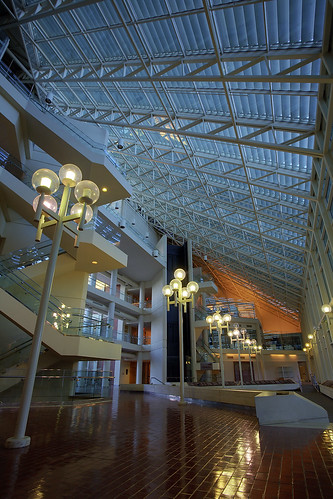
One of the architectural features of Oklahoma State University is the Noble Research Center, which I have walked past many times but never actually visited until recently. The south face of the building is dominated by a series of massive louvers which serve to create a fantastic sense of open space and scale in the inner lobby which makes the building ideal for photography. All the light and shadows playing off the various features inside work together to create an environment with so many photographic possibilities it’s difficult to know where to start. Unfortunately with a 50mm lens on a crop sensor camera, it’s a somewhat tricky proposition to capture the sense of grandeur and open air that is better suited for a much wider lens. I tried a few shots just looking up at the roof but those didn’t work at all, so instead I figured I would focus on one of the metal stair railings as a way of giving a bit of context to what would otherwise just be a photo of the ceiling.

I kind of like how the initial focus of the viewer is on the lower left, and then the eye should (in theory, anyway) follow the railing up to the top-right as a way of exploring the scene a bit. I shot this at f/4 to give a somewhat shallow depth of field, and there was so much light coming in that I was able to use ISO 200 to get a silky smooth image with virtually no noise at all. I think my favorite aspect of this image is that it introduced me to something new that has been right in front of my eyes for years, and in doing so kind of inspired me to seek out more of what OSU has to offer in the coming months.
Read my educational photography articles at Digital Photography School

Split Second

January 28, 2015 7 Comments

Split Secondhttps://www.weeklyfifty.com/wp-content/uploads/2015/01/WeeklyFiftyPodcast2015January28SplitSecond.mp3

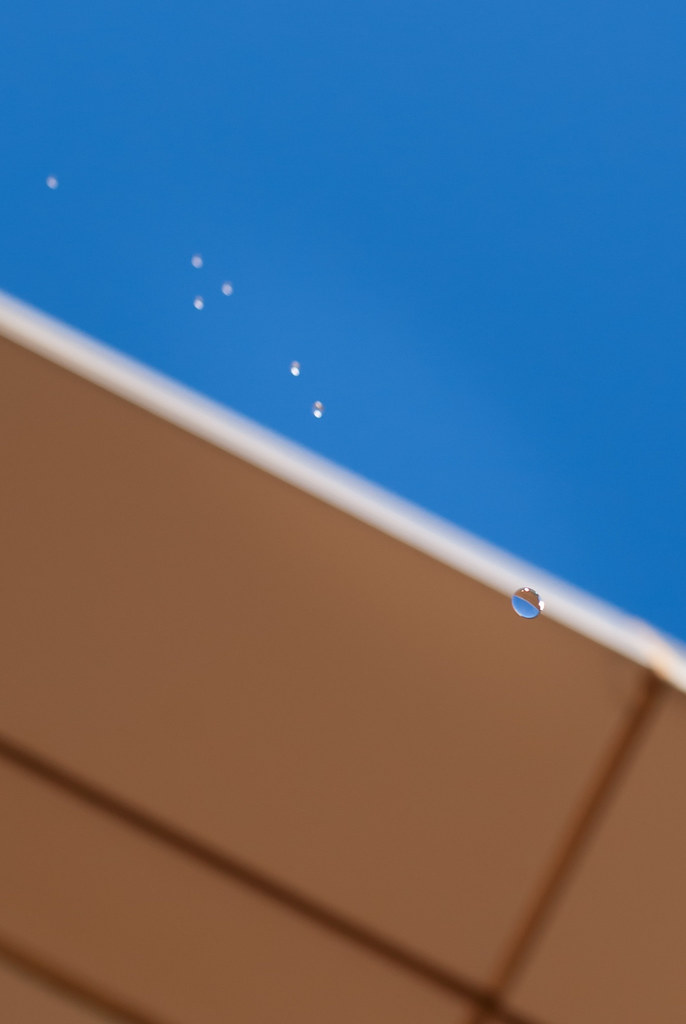
Sometimes I wonder when I will ever learn. Here’s yet another example of a picture I really like that came about purely by chance, and only because I took thirty seconds to pull out my camera and actually attempt the shot. I was walking out of a building the other day when I saw some big fat drips falling from an overhang, and nimbly sidestepped them as they splashed on the pavement. And that was that–no second thoughts given on my part, and a good photo opportunity nearly missed. But then I thought I would try, just try, to catch one of the drops as it was falling. I am horrendously self-conscious when it comes to taking photos, and because a) it’s something I’m working on, and b) no one else was around, I knelt down and aimed my camera right up into the path of the drips. No way was autofocus going to work, so I put my camera in manual, set the aperture to f/4 and ISO to 200, and just motor-drove until the buffer was full (which, thankfully, is over 20 RAW shots on my D200–three times the buffer size on my D7100 even though the latter is a newer and much more expensive camera). I kept scooting around on my knees with my camera aimed skyward hoping everything would line up for a good shot, and out of 43 images this was the only one in which the main drop of water was in focus. But wow, I sure am pleased with the results. I like the trail of smaller drops off to the upper-right, and decided to use a vertical orientation as opposed to my traditional horizontal style because it seemed to fit the mood of the picture better. I was also pleased with how the big drop perfectly inverts the colors of the overhang and the sky, and overall this required very little retouching in Lightroom.

Maybe one of these days I’ll stop worrying about what other people think, and just learn to be that weirdo with the camera who is always taking pictures of things. And like my brother Tom says, chances are no one will even notice, so why even give it a second thought :)

Read my educational photography articles at Digital Photography School

Color Pool

January 21, 2015 Leave a Comment

Color Poolhttps://www.weeklyfifty.com/wp-content/uploads/2015/01/WeeklyFiftyPodcast2015January21ColorPool.mp3

I look at this photo and still can’t believe it almost didn’t happen. Not that this picture is anything special really, but I do kind of like it and the cornucopia of colors swirling in the puddle–augmented by the leaf stem sticking up on the right-hand side almost like a punctuation mark on the whole scene. But when I shot this I was walking to my office about 9am on a dreary December morning and noticed a puddle right next to where I took a photo of some mushrooms a few months ago. It was cold, rainy, and though I had my D7100 + 50mm lens with me I was not really in a picture-taking mood. I just wanted to get inside and warm up, but a little voice over my shoulder told me to pause, set down my backpack (because briefcases are way lame), and just take a photo already. So I knelt down on the soggy grass and got to work.

I knew right away I wanted to use the leaf stem as a compositional element, but was not sure exactly how to use the rest of the photo to frame it. I shot a few pics with the leaf on the left-hand side, but it just wasn’t working out how I hoped. The colors weren’t as vivid, and I didn’t like the direction of the leaf stem–it was almost as if it was directing the viewer to gaze off the left-hand side of the picture. So I recomposed the shot (manually focusing again, because I didn’t quite trust the autofocus to nail the tip of the leaf stem) and was much happier with the results. And, as you might have predicted after listening to last week’s audio, I shot this at f/2.8 to make sure the DOF wasn’t out of control :)

The biggest challenge here was actually the editing. With so many buttons and sliders available in Lightroom it can be easy to go overboard, but I wanted to keep things reigned in while still getting a nice vivid image. Prior to editing the picture looked far too dull and lifeless, but that’s why I shoot in RAW: to have enough color data available to make the final image represent what I actually see in real life. Initially I had it way over-saturated, way over-contrasted, and even gave in to the temptation of Clarity Overload, but realized yet again that less is more, and finally settled on the version you see here.

Read my educational photography articles at Digital Photography School

Signs of Life

January 14, 2015 7 Comments

Signs of Lifehttps://www.weeklyfifty.com/wp-content/uploads/2015/01/WeeklyFiftyPodcast2015January14SignsOfLife.mp3

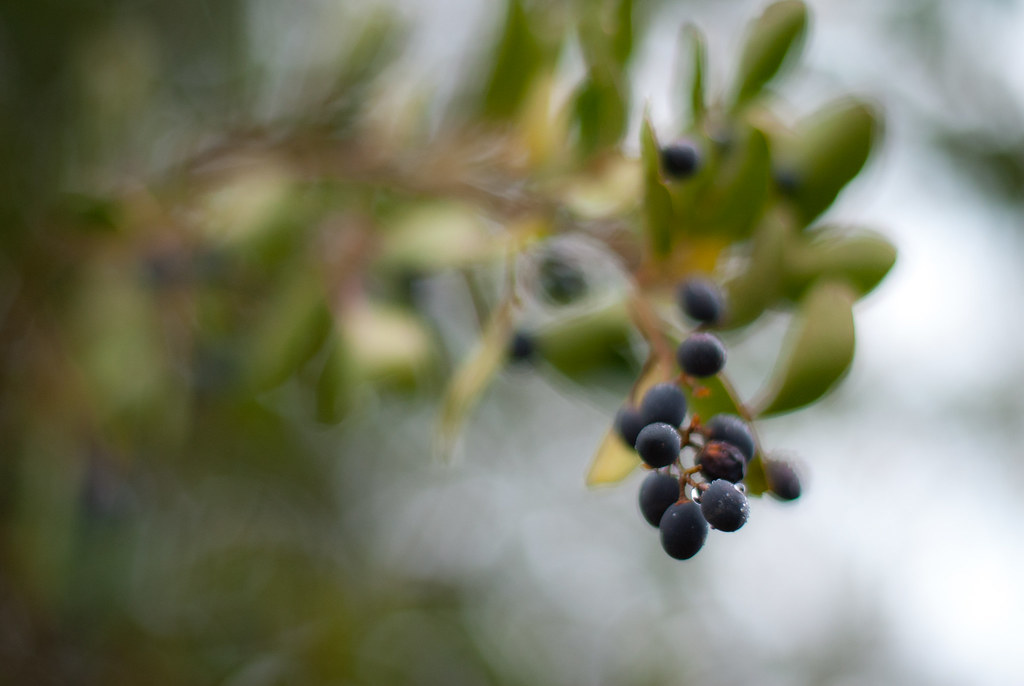
Originally I had not planned on posting this photo, but the idea came to me while recording the audio for last week’s image because I realized it functioned as a sort of companion to the Yucca Tails. It is similar in composition with the focal point being on the right-hand side, which then serves to draw the viewer’s eye back into the rest of the picture to see what else is present. In this case it’s a clump of purple…um…somethings (seeds? berries? I honestly don’t know, even though this is a tree in my very own backyard) instead of the branches of a yucca plant, but overall the sentiment is quite similar. It also has echoes of a photo I posted several months ago called “After the Rain,” and in fact I used some of the techniques I learned when shooting that as I captured this image. Perhaps it’s an unconscious stylistic choice, but I rather like this type of composition, even if some people might call it derivative.

The reason I decided to post it here is to function as somewhat of a cautionary tale regarding shallow depth of field. Since the sky on this breezy day was quite overcast and I was using my D200 at ISO 200 (I suppose in retrospect I could have just bumped it up to 400) I needed to let in as much light as possible in order to freeze the purple berry-thing in front. That meant using f/1.8, which I don’t often do because, well, as you can see the depth of field is, in my opinion, a bit too much. The bokeh almost distracts from the subject, and it borders on overpowering–particularly the green leaves just above and to the right of the deep violet subject. F/1.8 is great to have when you really need it, but in this case I think I should have just found a way to get the shot with a little less DOF. Still, I’m happy with the image overall and I think it’s high time I figured out just what this tree/plant/bush/whatever actually is that’s been behind our house ever since we bought the place :)

Read my educational photography articles at Digital Photography School

Yucca Tails

January 7, 2015 5 Comments

Yucca Tailshttps://www.weeklyfifty.com/wp-content/uploads/2014/12/WeeklyFiftyPodcast2015January7YuccaTails.mp3

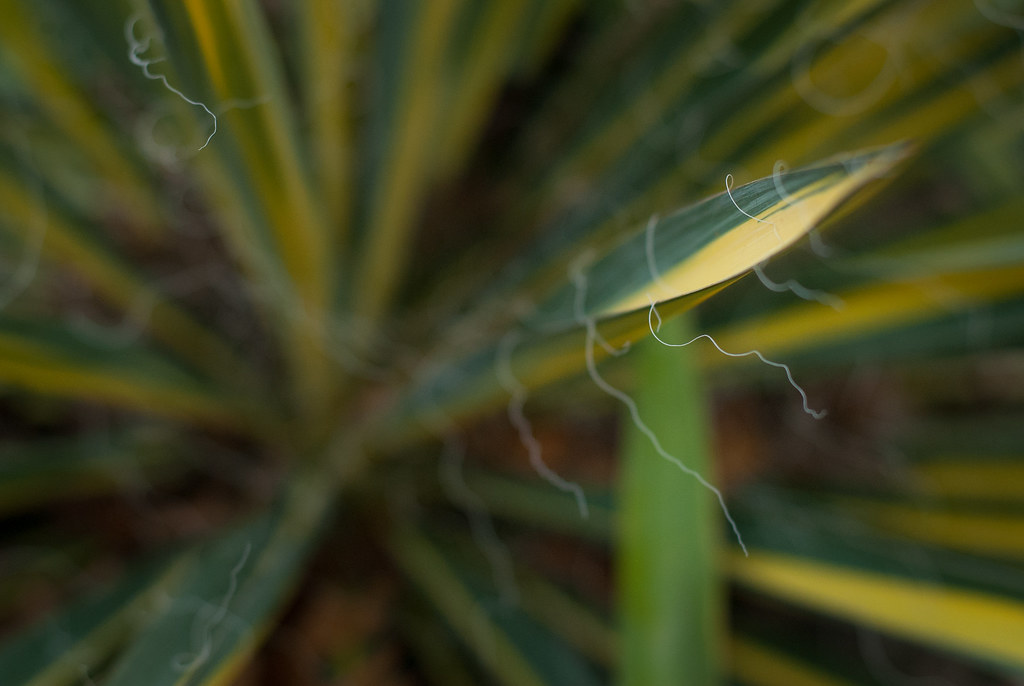
I certainly had no intention of capturing this photo when I went out on a brief walk one chilly December afternoon. My only goal was to get a picture of something, but I didn’t know what that would be. This time of year there’s a dearth of colors in nature, and on an overcast day like this one the world almost looks like it’s being displayed through a sepia filter. This splash of green caught my eye though, and when I looked closer and saw the little tendrils poking out from the side of its leaves I knew I had found my subject. The hard part, then, was figuring out how to shoot it in such a way that one of the wisps would be isolated against the rest of the plant. I ended up shooting this at f/2.8 (1.8 would have resulted in a depth of field that was simply too shallow, while f/4 or smaller would not have been able to isolate just one solitary strand like this) using manual focus, and it worked out pretty well. I don’t know anything about yucca plants, but I must say, if they can stay green through the winter then I’m already kind of sold on them.

Read my educational photography articles at Digital Photography School

  • « Go to Previous Page
  • Page 1
  • Interim pages omitted …
  • Page 125
  • Page 126
  • Page 127
  • Page 128
  • Page 129
  • Interim pages omitted …
  • Page 147
  • Go to Next Page »

Copyright © 2026 Creative Commons License
This work is licensed under a Creative Commons Attribution-NonCommercial-NoDerivs 3.0 Unported License.