• Skip to main content

Weekly Fifty

Exploring the wonders of creation through a 50mm lens...and other lenses too.

  • Subscribe
  • YouTube
  • About

Turtledove

July 5, 2017 8 Comments

Turtledovehttps://www.weeklyfifty.com/wp-content/uploads/2017/05/WeeklyFifty-2017-July-5-Turtledove.mp3

Several years ago when I first got started getting serious about photography, my buddies Ryan and Kevin convinced me to forego a kit lens and instead purchase a 50mm lens. That decision was directly responsible for lighting a fire beneath my feet, photographically speaking, and immediately opened my eyes to the vast world in front of me that I was suddenly able to capture in my camera how I saw it in my mind. I always wanted to experiment with shooting in low light, isolating my subject, getting tack-sharp portraits, and of course get those oh-so-blurry backgrounds but until I got that Nifty Fifty I thought some kind of secret alchemy was required that only True Photographers possessed. Turns out all you need is a 50mm lens*

The more I used my D200 + 50mm lens, the more excited I got at the possibilities it offered to me as a photographer. However, one thing continued to confound me and not too long after I got started with photography I, somewhat infamously, told Ryan that a 50mm lens is ill-suited for wildlife photography. In fact I could have hardly been further from the truth, and Ryan told me as much at the time, but ever the over-eager newbie I, over the next few years, tried my  best to prove myself right. Thing is, I was wrong. The 50mm lens is great for wildlife photography, depending on the type of wildlife you want to photograph.

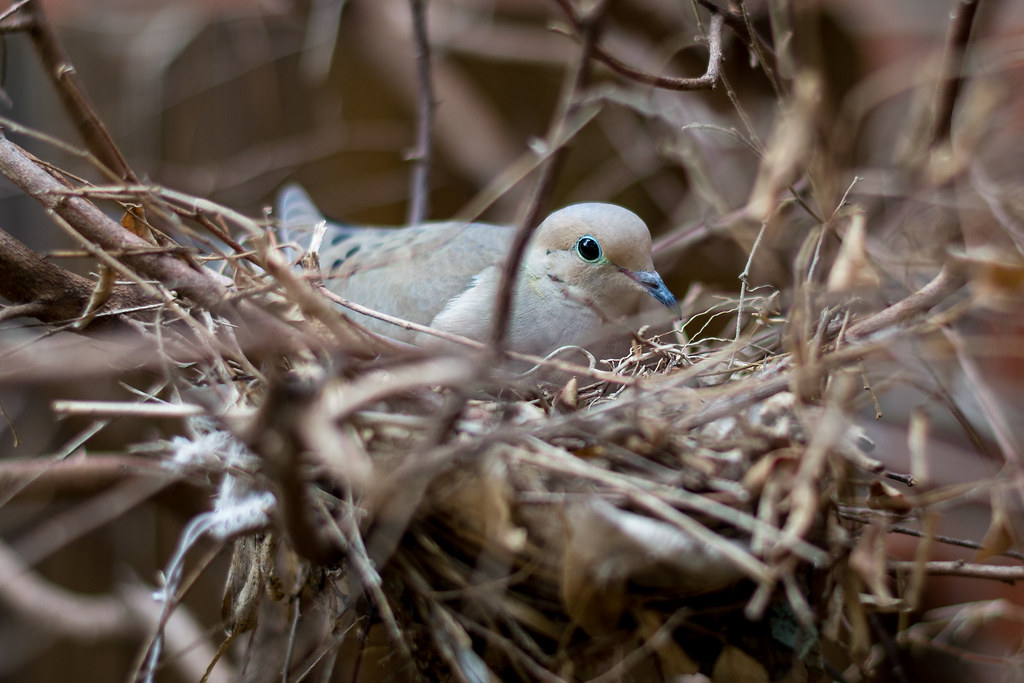
Case in point: today’s image of a turtledove peacefully resting in a nest. Could I have used a telephoto lens to get this shot? Sure, but that would have given me a more limited field of view compared to the comparatively wide angle afforded by a 50mm lens. All it took for me to get this image was patience and a bit of creativity, the limitations of a 50mm lens notwithstanding. Like so many photographic situations, it’s not the gear you have (or don’t have) but how you use it that matters, and a 50mm lens (or any lens, for that matter) can be perfectly suited to wildlife, landscape, sports, portrait, or any other type of photography so long as you are aware of its capabilities and limitations and allow yourself to work within that space.

Would a 50mm lens be ideal for getting close-up shots of lions while on safari? No, probably not. But could it capture lions on the horizon silhouetted against a sunset? Most definitely. Would a 50mm lens be ideal for getting tack-sharp images of a kingfisher diving for prey beneath the water? Not at all. But would it work to capture an intimate close-up of a turtledove sitting on her nest? Absolutely. This photo was taken right next to my house and the bird you see has gotten pretty used to a continual buzz of activity from my kids playing in the yard, which is probably why she didn’t mind when I climbed atop a stepstool just a few feet from her nest. She didn’t flinch much when I scooted closer…closer…closer with my camera while firing off a couple dozen shots. I even got down and moved the stepstool to reframe the shot, and she just sat quietly the whole time.

I guess my point is that this picture illustrates the same point I’ve been trying to make to myself for years here on Weekly Fifty: it’s important to know your limitations and then learn how to work within them to get the shots you want. Even if you don’t think the shots you want are possible, they probably are. It just might take a bit of patience and creativity :)
*ok…you don’t specifically need a 50mm lens since any lens will suffice. But read on to get the whole picture of what I’m trying to say.

Read my educational photography articles at Digital Photography School

The Early Flower

June 28, 2017 10 Comments

The Early Flowerhttps://www.weeklyfifty.com/wp-content/uploads/2017/05/WeeklyFifty-2017-June-28-Early-Flower.mp3

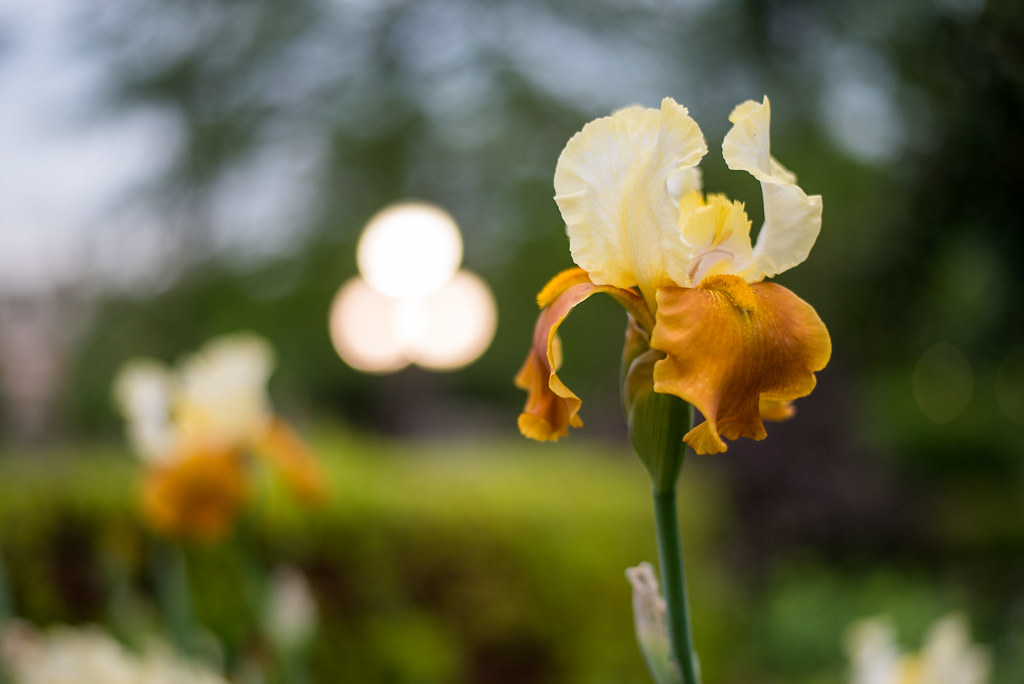
Taking this picture was kind of fun because I’ve realized that I don’t really take a lot like this anymore, which is kind of a shame. In truth I rather enjoy taking photos of flowers, but lately I’ve been mostly doing it with a close-up filter and thus missing out on some of the context and fun lighting that can come into play when composing a more normal view of something like this. As often happens with my Weekly Fifty photos I shot this early in the morning on my way to work, and with the sun just peeking over the horizon it meant a nice even diffused light covering the whole campus while also catching things at a time when the street lights were still glowing. And that’s where the fun part of this photo really came into play.

One thing I’ve learned when it comes to composing shots is that every element in the frame ought to be considered, from the foreground to the subject to the background and even other elements on the periphery that might not appear to matter. In this case there’s not much in the way of foreground elements, but I as I knelt down to take this picture I wanted to carefully pay attention to the background objects and compose my shot accordingly.

The subject is clearly the flower in front, but I also wanted to use another flower behind it as well as the triple-topped light post way in the distance as intentional elements of the shot. This required a bit of moving and maneuvering on my part while also taking my lens aperture into account. I shot a few images at f/2.8 and even a couple at f/4 but soon realized that while the subject was tack sharp in these, the background elements were not as blurred out as I wanted and thus the viewer’s eye was distracted and listless with no clear focal point. Thus I spun the dial on the front of my D750 clear to the left to get as wide of an aperture as possible, knowing full well that shooting at f/1.8 would mean an almost-too-shallow depth of field.

The results turned out pretty well, and though the yellow-orange petal closest to the viewer is a tad out of focus I’m glad that the rest of the flower is quite sharp. Ideally I think I would have physically separated the three elements of the shot (foreground flower, background flower, and light pole) with a bit more space instead of crowding things so close in the center of the frame, but overall I think the image is decent and a good reminder of why it’s fun to un-screw the close-up filters and just go take colorful pictures from a more normal point of view sometimes.

Read my educational photography articles at Digital Photography School

Gently Weeping

June 21, 2017 2 Comments

Gently Weepinghttps://www.weeklyfifty.com/wp-content/uploads/2017/05/WeeklyFifty-2017-June-21-Gently-Weeping.mp3

Taking this picture felt, in some ways, like the culmination of so many thing I have learned about photography over the years. From composing the shot to controlling the exposure to postprocessing…and even just seeing the photo opportunity in the first place, it all sort of coalesced into the picture you see here. I hope you don’t mind me saying that I quite like it and, at the risk of sounding a bit self-aggrandizing, I think it’s one of the better macro-style shots I have taken in a while.

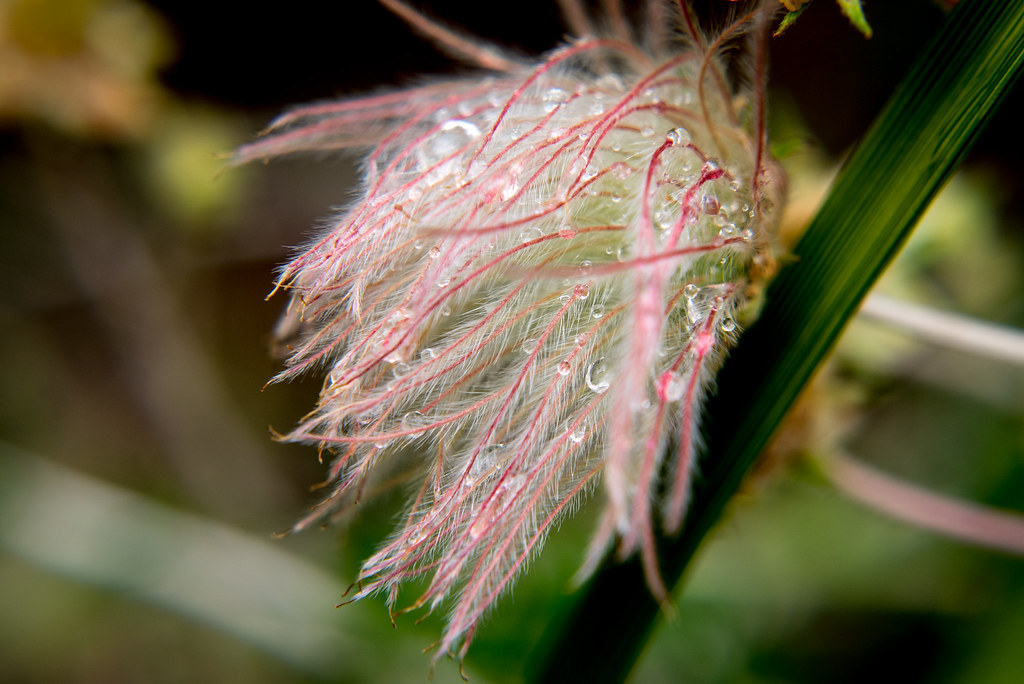
So here’s kind of the play-by-play of how this shot came about. I was walking across campus one afternoon recently, following some light spring showers that had blanketed the city in a warm mist earlier in the day, and saw this tiny little…something. You all know by now that I’m no botanist and have little to no clue about what various plants actually are, but this thing was about the size of a quarter and I thought it looked so pretty, and delicate, with beads of water clinging to those fine white-and-red strands. Thankfully I had my D750, 50mm lens, and my usual set of close-up filters handy though I should let you know that I actually walked right on past this thing at first because I didn’t think it would really be worth photographing. I’m sure glad I was wrong.

I took one shot with my +4 filter and immediately realized I would need my +10, so I put that on and took a few shots at f/8. I didn’t bother with anything wider since I knew (after a lot of trial and error which has been well documented here on the blog) that f/8 would make sure much of the subject would be in focus while still getting a nice amount of background blur and also result in a sharper picture overall. The only real question was the angle at which I was shooting, and I moved my camera around a bit to get a couple of different viewpoints but in the end I only spent about two minutes on this shot before moving on, confident that I had something I would like.

Sure enough, when I loaded the images in Lightroom I found that I was perfectly pleased with most of them, so then it came down to a matter of personal preference. What ultimately did it for me on this particular shot was how sharp it turned out. If you click on the image and zoom in to 100% on Flickr you will notice that even the smallest wisps in the middle of the image are extraordinarily sharp, which doesn’t often happen when I do close-up shots like this. Of course there are plenty of strands that are not sharp due to the shallow depth of field (even at f/8) but right in the middle, where I hope the viewer’s eyes are drawn, is precisely what I was hoping it would be.

And so there you have it: a reason to keep practicing, trying new things, and taking pictures even when you don’t think you have anything around you worth photographing. Pause a moment and look at the world around you, and you just might find yourself in the presence of something beautiful.

Read my educational photography articles at Digital Photography School

Flying Aggies

June 14, 2017 6 Comments

Flying Aggieshttps://www.weeklyfifty.com/wp-content/uploads/2017/05/WeeklyFifty-2017-June-14-Flying-Aggies.mp3

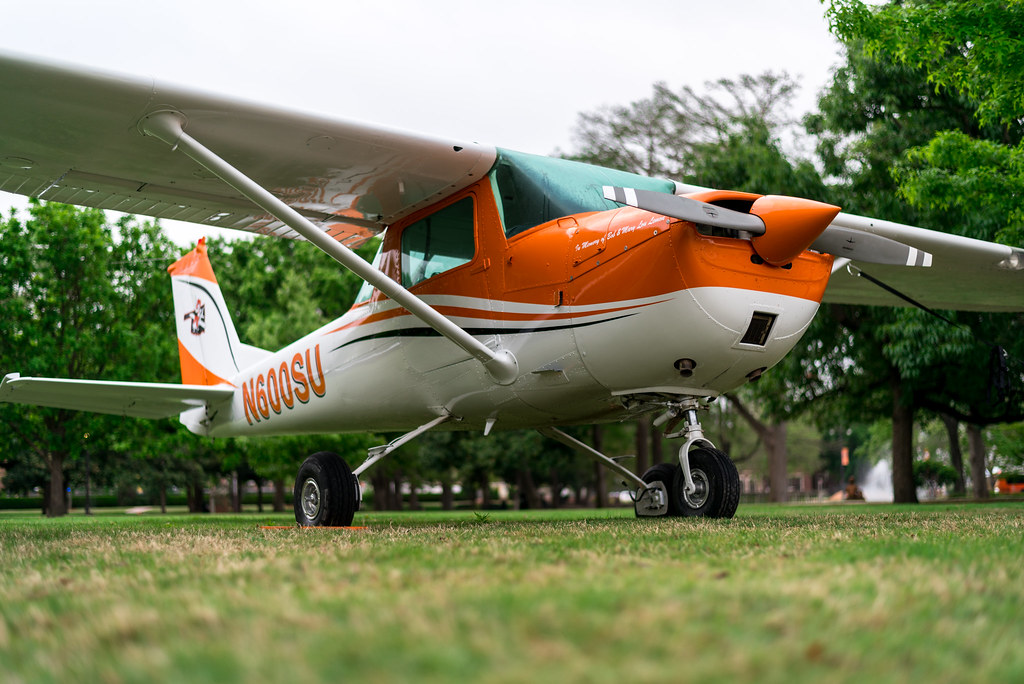
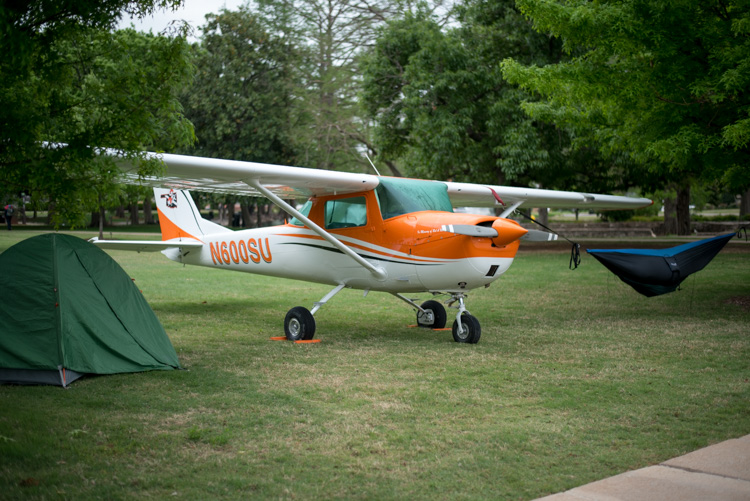
Sometimes I write about how unique and fascinating it can be to work on a college campus, and this shot is a good example of what I mean by that. There I was, walking to work on a drizzly Wednesday morning when lo and behold I came across an airplane sitting in the lawn just north of Theta Pond. (Look closely in the background and you can see one of its fountains.) At first I was a bit confused, and then when I noticed a tent on one side and a hammock on the other side, I was even more befuddled. Then I remembered that about this time in 2016 the OSU aviation students, otherwise known as the Flying Aggies, had parked the same plane at the same spot in order to spread the word about who they are and what they do.

I had a few minutes before I was supposed to be at work so I crossed Monroe, got out my D750 + 50mm lens, and took a few pictures. At first, like most people, I stood and shot from eye level and ended up with a couple images like this:

It’s not a bad shot and in some ways I kind of prefer it to the one I actually posted for this week because the trees and tents serve to create a somewhat unique and compelling story. Ultimately I decided that there was just too much going on in the frame, and with the colors of the tents being so similar to the surrounding scenery anyway I thought it would be best to just focus on the airplane. Basically, the one taken from eye level looked more like a snapshot whereas the one I decided to actually use felt more like an actual composition. I don’t know if I’m just grasping at straws here, and I might be, but I really do feel like there’s a substantive difference between the two.

I walked a bit closer to the plane, crouched down on the ground, and fired of a couple shots that I still wasn’t quite happy with. I was using f/1.8 to really bring the front of the plane in focus while getting a bit of foreground and background blur, which is difficult to do when your subject is so large and you’re standing several feet away, but something about the perspective just wasn’t working for me. Thankfully my D750 has a little flip-out screen which I rarely use, but when I need it oh boy does it ever come in handy. I literally set my camera on the sidewalk, angled it up, switched on Live View, popped the screen out, and voilà. I got the shot I was aiming for. The low angle and closer perspective helps isolate the plane and give it a sense of power and presence that the other shots lacked, and I’m happy with how the tail is perfectly visible but slightly blurry too.

Read my educational photography articles at Digital Photography School

Escape

June 7, 2017 18 Comments

Escapehttps://www.weeklyfifty.com/wp-content/uploads/2017/05/WeeklyFifty-2017-June-7-Escape.mp3

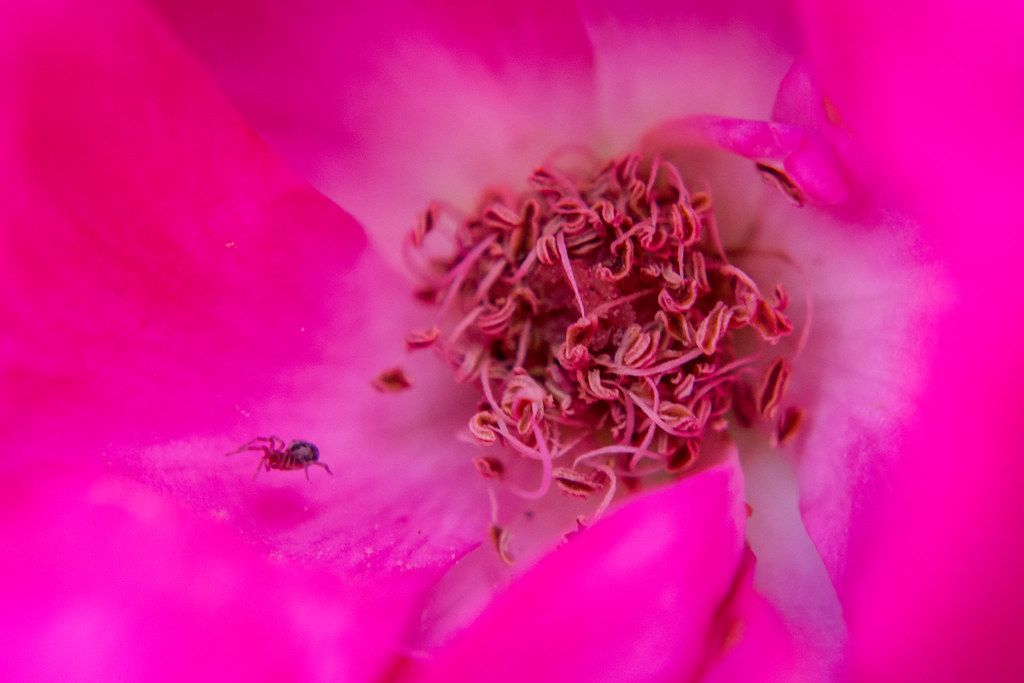
Ah, yet another in the long-running series of shots brought to you by my set of close-up filters. This one was a bit of a surprise for me for a couple of reasons, not the least of which is the sheer amount of pink and red in the image. I mean, wow. It kind of hurts my eyes just to look at it which is why I nearly dismissed the picture entirely upon seeing it in my Lightroom catalog. And yet I decided to keep it, edit it, and ultimately post it here on Weekly Fifty because of reason two. When I was looking around one of the gardens on campus armed with my D7100, 50mm lens, and close-up filters I was only looking for some flowers and not anything in the way of animal life since at this point I’ve basically ruled out the possibility of capturing bees, bugs, flies, or anything of that nature with the skill and equipment I have. I mean seriously, when there are photographers who can do stuff like this, it simultaneously inspires me while also making me want to chuck my camera in the trash because I’ll never be that good.

But as I often tell my five-year-old son, it’s not a competition. If I’m using my camera to capture images I like, then it’s all good. Hopefully I’m also getting inspired and challenged by other photographers and using their works as creative outlets to explore personally, and that all goes back to Reason Number Two which you might have noticed I haven’t exactly articulated  yet.

See that little bug in the lower-left of this photo? I kid you not, I didn’t even notice it (he?) was there when I shot the image. He must have been about 1/8″ long and I was concentrating so much on the center of this rose that I didn’t even notice the insect crawling outwards towards the sunlight. It was only afterwards in Lightroom that I saw the little fella boldly bolting towards the outskirts of the flower, and thought it added an interesting dynamic element to an otherwise fairly simple shot. I’m a little disappointed that the bug is not in focus, but it’s close enough and while I wouldn’t go with close enough when working with clients, it’s just fine here since I see it as a demonstration of my learning and photographic progression.

I do think I need to take more time and really see the world around me, especially when shooting subjects at close distances, and now I wonder how many other little hidden secrets like this I’ve been missing. It makes me want to get my camera out and start crawling around on the ground just to see what I can find :)

Read my educational photography articles at Digital Photography School

  • « Go to Previous Page
  • Page 1
  • Interim pages omitted …
  • Page 90
  • Page 91
  • Page 92
  • Page 93
  • Page 94
  • Interim pages omitted …
  • Page 138
  • Go to Next Page »

Copyright © 2026 Creative Commons License
This work is licensed under a Creative Commons Attribution-NonCommercial-NoDerivs 3.0 Unported License.