• Skip to main content

Weekly Fifty

Exploring the wonders of creation through a 50mm lens...and other lenses too.

  • Subscribe
  • YouTube
  • About

Duck Hunting

August 24, 2016 7 Comments

Duck Huntinghttps://www.weeklyfifty.com/wp-content/uploads/2016/08/WeeklyFifty2016August24DuckHunting.mp3

I used to teach English at Meadow Creek Christian School (now called Legacy Christian Academy) in Andover, Minnesota, and one thing I stressed to my students who were struggling with narrative-style writing is to start by simply writing what they know. Using our own lives as a backdrop for writing stories, whether fiction or nonfiction, is a fantastic way to help bring out our inner authors. Tolkien used his experiences in World War I as the backdrop for the conflicts in his Lord of the Rings tales. Michael Crichton imparted his extensive knowledge of science and medicine into his many books, movies, and television shows which he had a hand in creating. Even John Grisham, purveyor of many of the most popular legal thrillers today, began his career as an author only after practicing law for ten years and then used that as the basis for his creative works.

What I’m getting at here is that sometimes it’s good to branch out into new and unexplored territories, but sometimes it’s nice to stick with what you know. There’s nothing wrong with treading in familiar waters—how often did you see Bob Ross do cubist-style paintings or try his hand at marble sculptures? And that’s what’s happening in this picture of a relatively normal white duck. There’s a small pond on the OSU campus that is a favorite spot for me and many of our students and faculty, and even though it’s somewhat cliché to wander down there and take photos of the animals…well, who cares? I still like doing it. It’s not groundbreaking or earth-shattering, but pictures of the geese and ducks are fun and can often be challenging too, especially when shooting with a 50mm lens because the animals, despite their familiarity with humans, still like to keep a healthy distance.

On this particular afternoon my friend Gina had brought some duck food along while we went on a short walk around the pond (apparently the stuff is super cheap! She bought 40 pounds of it from a local farm supply store for about $7) and it was fun to see the waterfowl overcome their trepidation and get very up close and personal with us while we fed them. I had my D750 with me so I used the opportunity to take some pictures, and you know what? I like this one and don’t even care that there are probably ten thousand others just like it. Taking this picture made me smile and it’s a fun little reminder of how there is nothing wrong with just doing what works.

Read my educational photography articles at Digital Photography School

Færie

August 17, 2016 8 Comments

Færiehttps://www.weeklyfifty.com/wp-content/uploads/2016/08/WeeklyFifty2016August10Faerie.mp3

This photo honestly took me by surprise just a little bit. On a warm Sunday afternoon in July my wife and I were at the local botanic gardens with our two boys and as they played with one of the exhibits (some kind of hand-operated water pump connected to a trough and an underground storage tank) and we wandered around talking while looking at the local flora. It was one of those lazy, relaxing kind of days where there is no real agenda other than to get out and enjoy nature and we wanted to take advantage before it got too sunny. Soon our boys migrated to a spot within a grove of trees containing a few interactive art pieces to play with, so we went with and played along while snapping a couple pictures just for the fun of it.

As we were getting ready to head back to the car I spotted this tiny winged woodland lady frolicking among the branches, and crept in close to get a better look. She was kind enough to hover silently while I drew near with my D750 + 50mm lens, and turned a few pirouettes while I snapped some pictures. I didn’t want to disturb her lest she cry out for Oberon or Puck to come to her rescue but I did linger long enough get about a dozen photos before retreating to the outside world. Her slow twirling made it somewhat difficult to get the images I was looking for, and what I ended up with is actually not at all what I intended at the outset. I thought it would be fun to get a picture of her on the left side of the frame while also angled slightly so as to possibly show a bit of movement, and while I did in fact get that picture I did not really like it much:

\DFF_7061

Looking at the photos in Lightroom I realized that her slightly skewed composure made her look strangely distorted, and the extrusion of this two-dimensional shape in order to add depth only served to make such a picture look strange and even a bit disconcerting. I had about a dozen images just like this one but fortunately I also managed to capture one–and only one–of this little lady directly from the side which is what I ended up using as this week’s featured photo. I shot it at f/4 which, thanks to my full-frame camera, gave me the equivalent depth of field as if I had shot this at f/2.8 on a crop sensor camera and resulted in a very pleasing composition overall.

I thought it was cool to see this little scene in the gardens on that day, and it made me think of how we often decorate Christmas trees with similar trinkets and tchotchkes but put them away once the season passes. Why do we do that? Why not add a bit of life and inspire a sense of wonder in the world around us by adding special charms like this to our yards during the rest of the year? It seems like a fun activity to do, and I think I’m going to try to get on this with my own kiddos and find ways of adding a little extra spark of life to the natural world outside our house and the world around us.

Read my educational photography articles at Digital Photography School

Upstairs

August 10, 2016 11 Comments

Upstairshttps://www.weeklyfifty.com/wp-content/uploads/2016/08/WeeklyFifty2016August10Upstairs.mp3

Ah, the classic sunstar-from-behind-a-building photo. It’s one I’ve done many times before and yet it continues to be the type of picture I really enjoy revisiting. When I took this I had no special intention of making the particular picture you see here but I’m quite happy with how it all turned out. At the time I shot this I was running an errand at work and, as I often do, I brought my camera with me. On this occasion it was my D750 + 50mm combo which I knew would give me a little wider field of view than my D7100, so when I saw the sun poking out from behind the stairwell on a parking garage I thought it might make for a slightly more interesting photo than I would normally get with my crop sensor D7100. For me the biggest consideration here was of a compositional nature: there were three elements at play, and I had to decide how I wanted them to all interact within the frame. The parking garage, the sky, and the sun all come together to form a cohesive whole, and I had to figure out where I would stand and point my camera in order to get the shot I was looking for. (FYI, nothing here was cropped. What you see is what I got.)

Ironically the first thing I decided was the aperture of my lens; when shooting a starburst like this you need to stop your lens down quite a bit to get the light to make that cool star pattern which usually requires something around f/11 to f/16. I set my camera to f/13 and moved around until I could just barely see the sun poking out from behind the roof of the stairwell, which is key for a shot like this. If you point your camera straight at the sun you will just get a giant overexposed blob, so you have to get just a bit of the sun peeking out from behind something else like a tree or building.

After deciding my aperture I tried a couple different places to stand that would still show a bit of the sun and took a grand total of five images from slightly different angles. The sky was actually quite overcast which meant I was able to pull out a great deal of blue color detail in Lightroom that would have normally been way, way too overexposed to salvage and I also used the Healing brush to take out about a half dozen little brown spots on the concrete side of the structure.

To me this picture is somewhat of an exercise in how to convey a sense of size or create a particular mood, as well as a reminder of how much I have grown as a photographer in the last several years. If I had made this image in 2012 I would have taken 50 shots from all sorts of angles and tried all kinds of different settings, but here I only took five and it was over in less than a minute. These days I have a much better idea of how to control my camera to get the shot I want, and I try to avoid taking dozens and dozens of photos of the same scene to get that one perfect shot. There is no such thing as the perfect image, and instead I try to get photos that I like and with which I am well pleased, and then go back to my life. That’s what happened here and I hope you like this shot too :)

Read my educational photography articles at Digital Photography School

Giddy

August 3, 2016 16 Comments

Giddyhttps://www.weeklyfifty.com/wp-content/uploads/2016/08/WeeklyFifty2016August3Giddy.mp3

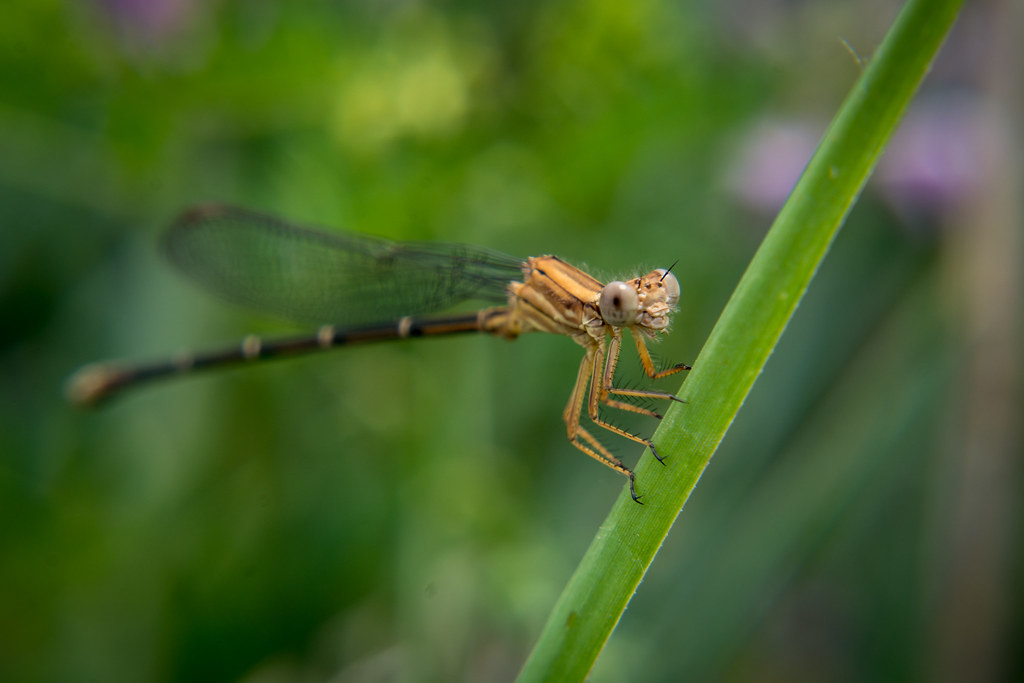
When I was a kid my family used to spend a week each summer at a lake near Brainerd, Minnesota, playing at the beach, catching turtles with paddleboats and fishing nets, going tubing behind my uncle Paul’s boat, and staying up talking with relatives around the campfire. For some reason I distinctly remember the sight of dragonflies on those vacations, and when I was a kid I was absolutely fascinated at these strange anachronistic creatures that looked like they were ripped right from prehistoric eras and placed squarely in our modern-day world. I remember seeing them buzzing around us when were out on the boat or sitting in tubes near the beach and being at once amazed and horrified by their strange design.

Nearly 30 years later when my family was on vacation in Kansas a few weeks ago my brother Phil asked if I wanted to go bug hunting with him, armed with our cameras and close-up lenses. I gladly agreed and we set off near the beach at Milford Lake to go see what we could find among the foliage. He had a big advantage since he was using a 55-200mm lens with a +2 filter attached (I think. Or it might have been a +4.) that let him stay farther away from various bugs and insects but still take good shots. Far more, in fact, than I was able to get with my 50mm lens :) We were surrounded by not only dragonflies but bees, flies, beetles, and myriad other bugs but the problem, I soon realized, was that whenever I would get close enough to one of these little creatures it would scamper away by the time I could get things in focus and fire off a few shots. We were only bug hunting for maybe 20 minutes but I spent much more of that time chasing away insects than taking their pictures, and it was quite a learning experience for me in that regard!

After a little while Phil pointed out the dragonfly you see in this week’s image, and after taking some pictures he stepped aside and I eagerly moved in to see what I could get. I was using my +10 filter which meant I had to be about three inches away, but this gold-colored dragonfly didn’t really seem to mind too much. In fact I don’t think he minded anything at all, judging by the look on his face :) I shot this at f/8, ISO 160, 1/180 second which was more than fast enough given that the insect wasn’t moving at all, and much smaller than f/8 would have given me a depth of field that was simply too shallow. As you can probably tell by the slate of recent pics here on Weekly Fifty I’m really enjoying these close-up filters, and if you don’t have some yet I’d highly recommend getting a set. They’re very cheap and can introduce you to a whole new world of photographic possibilities!

Read my educational photography articles at Digital Photography School

Transition

July 27, 2016 12 Comments

Beforehttps://www.weeklyfifty.com/wp-content/uploads/2016/07/WeeklyFifty2016July27Transition.mp3

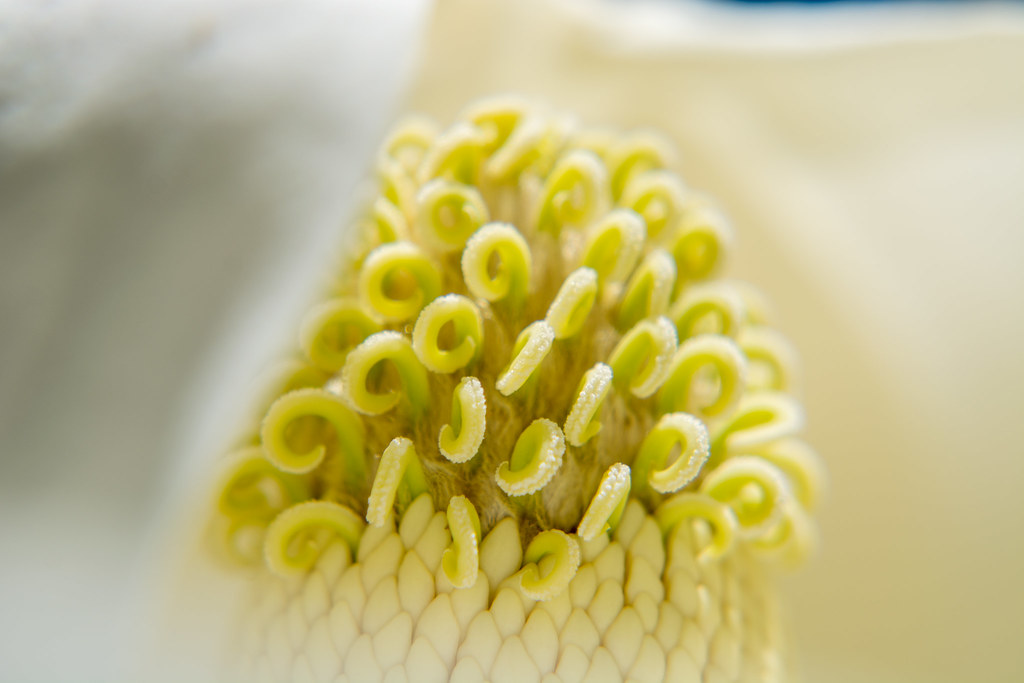
This photo came about somewhat by accident, and not really how I intended, but led to a series of images of which I am rather fond nonetheless. I have posted some pictures over the years involving magnolia trees, which are quite prevalent here in this part of Oklahoma, and the beauty of their flowers never stops being amazing to me. I hope, then, that you won’t mind yet another photo (or two or three) of the same subject :)

When I shot this picture I was on a short walk and wasn’t really looking for an image quite like what you see, but I did know I wanted to capture a magnolia flower somehow using my D7100 and a close-up filter. (I think might have been either a +4 or a +10 but can’t remember which.) Not 30 seconds into the walk I came across this flower which was just starting to emerge, and as I took a few shots I specifically framed the subject so it was being blocked a bit on the left-hand side by one of its own massive petals. I wanted to create a scene almost as if the viewer is peeking in on the beginning of something fascinating not unlike when a baby raptor emerges from its egg in the original Jurassic Park. Though hopefully this flower is much more benign.

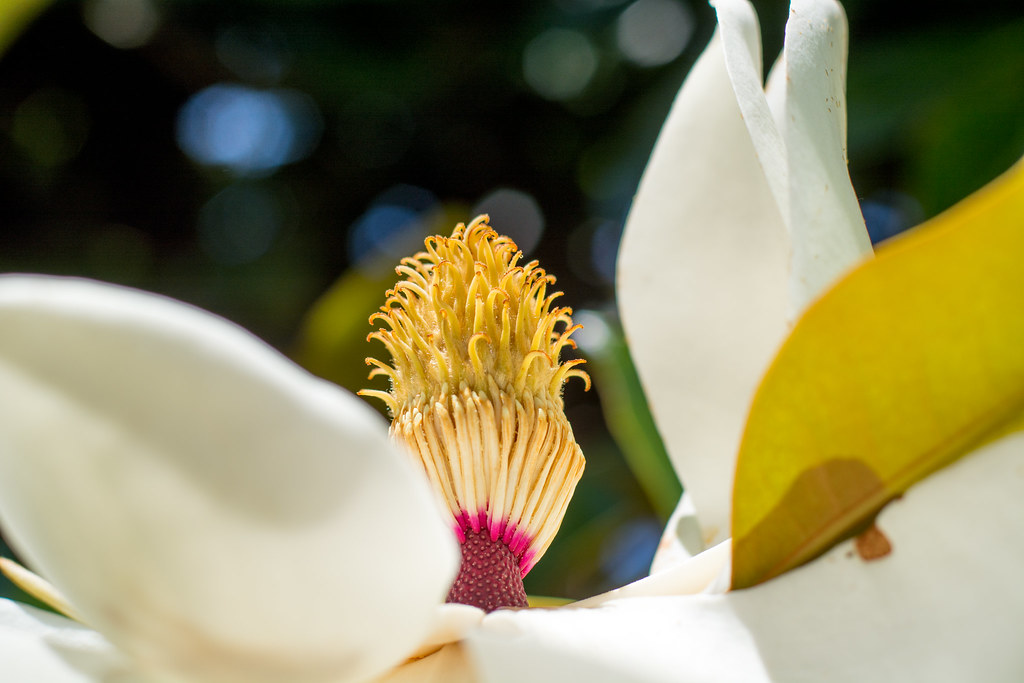
I thought the image was decent but kept on looking around for something…different. On another tree I spotted this flower which was much farther along in its progression:

DuringFor this image I removed the filter so I could get a little more context for the flower. I wanted to see some of the petals and surrounding scenery which wasn’t really possible with a close-up filter attached. I shot from a low angle because I thought it would be more appropriate to see this flower reaching, stretching, lifting high into the sky like Andy Dufresne at the end of Shawshank. (Though ironically, that scene was shot from above in kind of the opposite fashion. Hmm. Perhaps I need to re-think my technique.) It made no sense to use a filter on the second image because it would have severely restricted my field of view and given the viewer no sense of context at all, and I liked the idea of showing the petals opening wide as the ball of pistils raised the anthers high almost like a chorus of worshippers praising God on a Sunday morning. In his gospel Luke recounts a scene in which Jesus tells the religious leaders of the day that if his disciples are not allowed to speak, the rocks and stones around them will cry out with praises to the Lord. I don’t know if they had magnolia trees in Israel back then, but it sure looks to me like that’s what is happening here in this picture :)

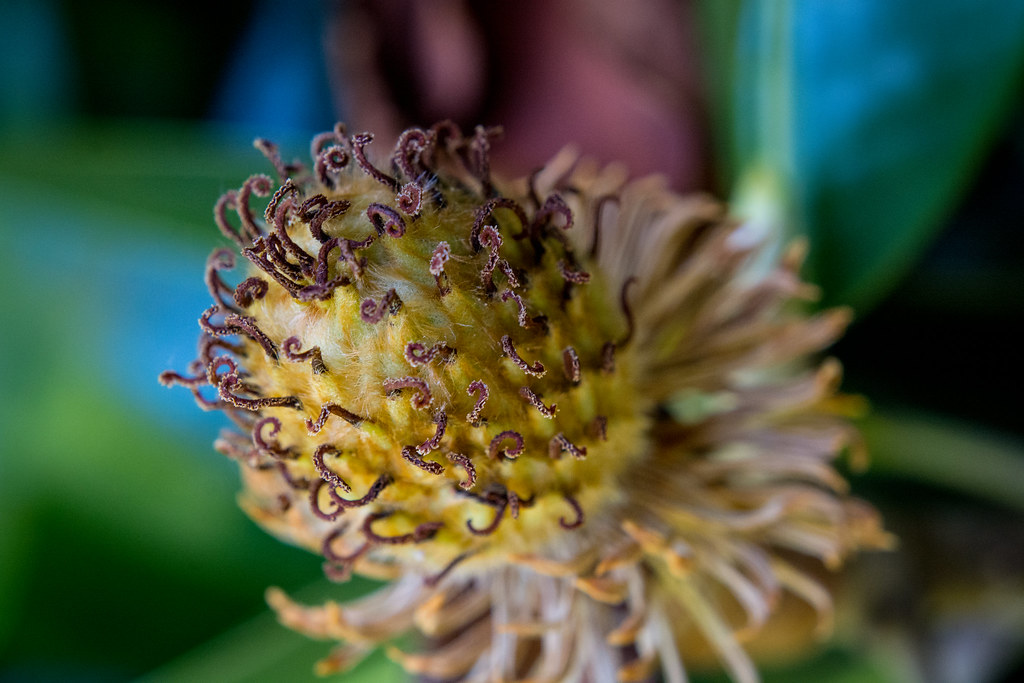
As I rounded the tree I came upon one final scene that shows the progression of a magnolia flower, and even though the beauty and glory has faded there is still much to be seen.

AfterThe anthers are withered, the pistils are faltering, and yet despite the impending sense of loss and decay there is hope to be found here as the flower has served its purpose, and in its death there lives hope: inside the ball of pistils are dozens of bright red seeds only beginning to take form, and in a few months what was once a flower will be transformed into a thick green shell which will house them until they are fully mature. After that the shell itself will wither and die, exposing the seeds which may take root and turn into majestic trees of their own someday.

I wasn’t expecting to capture all this on a single 10-minute walk one warm May afternoon, but that’s the nice thing about photography. You never know what you’re gonna get.

Read my educational photography articles at Digital Photography School

  • « Go to Previous Page
  • Page 1
  • Interim pages omitted …
  • Page 108
  • Page 109
  • Page 110
  • Page 111
  • Page 112
  • Interim pages omitted …
  • Page 146
  • Go to Next Page »

Copyright © 2026 Creative Commons License
This work is licensed under a Creative Commons Attribution-NonCommercial-NoDerivs 3.0 Unported License.