• Skip to main content

Weekly Fifty

Exploring the wonders of creation through a 50mm lens...and other lenses too.

  • Subscribe
  • YouTube
  • About

Ambition

April 13, 2016 13 Comments

Ambitionhttps://www.weeklyfifty.com/wp-content/uploads/2016/04/WeeklyFifty2016April13Ambition.mp3

To me this photo is an illustration of how important lighting and time of day can be when it comes to getting the shot you want. I took this picture as I was walking past Theta Pond on campus before work one morning specifically because I wanted to basically get a do-over for a picture I took the previous day. At that time my coworker and I took a short break to go for a walk around the pond and then back to our office, and on the way I saw this patch of flowers so I stopped for a picture. What I got was decent but rather uninspiring:

DSC_5166

The main problem here is the light: the overhead sun creates all sorts of harsh shadows that create a stilted and uninviting scene. The flower in front looks like it is tilted downwards as if shying away from the light, and the picture feels a bit cold and distant despite showing a rather colorful garden of white and yellow flowers. Admittedly the colors are all a bit brighter and have a greater sense of contrast, but I think that leads to a less pleasing image overall. My solution was to revisit the same location right when the sun was coming up to get a better picture and I think I mostly got what I was looking for.

Ever since I watched Sam Abell’s lecture on The Life of a Photograph I have been trying much harder to microcompose my pictures. This involves getting the overall composition set up properly but then adjusting your point of view so very small things are also aligned how they should be. Case in point: the flower in the top photograph struggling to reach up to the sky while the rest of the flowers are still tilted downwards. A properly composed picture would have the entire flower, petals and all, situated in the dark area between the two bright spots in the background. My picture suffers a bit due to this oversight in microcomposition and is left with a bit less of an impact overall. Imagine if the entire bright flower were set against the dark background and how much more it would stand out as a result, but alas, the photo remains a solid B instead of an A. Like so many things here on this blog it was a learning experience and I fully intend to do better next time, or the time after that, or the time after that…and that’s how the game of photography goes :)

Read my educational photography articles at Digital Photography School

Engagement

April 6, 2016 8 Comments

Engagementhttps://www.weeklyfifty.com/wp-content/uploads/2016/03/WeeklyFifty2016April6Engagement.mp3

There’s a bit of a story behind this photo that I thought would make it particularly interesting to post here on Weekly Fifty. Over four years ago when our son was just a few months old my wife and I continually struggled to get good-looking non-blurry photos of him with what we thought was a very nice pocket camera. (And one that we still have and use from time to time.) Kevin, the guy in the picture, was my friend and coworker at the time (he’s still my friend, but no longer my coworker as he now lives 60 miles away) and he and another coworker named Ryan helped me learn, quite literally, almost everything I know about photography. I didn’t know an aperture from a bag of Doritos and thought about getting a D3100 with a kit lens because it was supposed to take good pictures. I had heard the old familiar refrain of “it’s not the camera, it’s the lens” before but all I saw when I looked at cameras online was spec sheets and feature lists telling me this camera is cooler than that camera, and here’s a camera that you’ll like better than the other one, and even talking about all this with my buddies did little to assuage my ill-founded desire to get a fancy new camera with a kit lens. I mean honestly, how much difference could the lens make anyway?

With much patience over a few weeks of time Kevin and Ryan helped me see that it wasn’t the camera but the lens that really mattered, and on one afternoon when Kevin came over to our house to let me and my wife play around with his Nikon D200 and 50mm f/1.8 lens we were hooked. My wife and I bought a D200 and a 50mm lens and the rest, as they say, is history. That super old camera combined with a really nice lens immediately helped us get significantly better photos of our child, and I could hardly believe how much better all our pictures were compared to everything we had been able to get from our pocket camera. Several months later I created Weekly Fifty, a year after that I started writing for Digital Photography School, and in March of 2015 my wife and I decided to see if we could actually make some money at all this picture-taking stuff with our side project Stevens Creek Photography.

That leads me to this week’s picture. Kevin recently asked his longtime girlfriend to marry him, he and his fiancée asked if I would take engagement photos. I don’t know if I can quite explain how honored I was to be able to do this, not only on a professional level in that a couple would entrust these special moments to be documented by me and my camera, but on a personal level as well since it was a sign of the confidence that Kevin had in me as a photographer. I talk here on the blog all the time about understanding the basics like aperture, shutter, and ISO along with more esoteric concepts like framing, composition, mood, subjects, lighting, and the like and this photo session was a concrete example of how all that practice has paid off. The three of us spent a few hours at various locations and I came back very pleased with the pictures, and the two of them have told me on more than one occasion how much they like their photos as well. And it all started with Kevin, his D200, and a 50mm lens.

This picture was taken with the same 50mm f/1.8 lens I have had since the beginning but on my much-newer D750 and it’s a nice reminder of how much I have learned over the years. I would have never been able to take this shot without all the pictures of flowers, wagons, trees, toys, shoes, rocks, and other things I have shared here on Weekly Fifty though I see this not as the end but just the beginning. In many ways I feel like I have more to learn now than when I first started out, and I’m excited for the photographic journey ahead.

Read my educational photography articles at Digital Photography School

Tired

March 30, 2016 10 Comments

Tiredhttps://www.weeklyfifty.com/wp-content/uploads/2016/02/WeeklyFifty2016March30Tired.mp3

This week’s picture isn’t so much about the photo itself, but about the power of photography as a medium of expression and how it presents a specific view of reality. When you see this image, I have two questions for you:

  1. Where do you think it was taken?
  2. What do you think is the backstory?

For me the picture seems like something you might find in a brochure about impoverished countries in need of aid, or perhaps it would go along with a story about rural farmers struggling to make with a rapidly changing climate. Maybe this tire is a relic from a long-abandoned farm, or maybe the trees and dusty ground are about to be paved in favor of an urban revitalization project. What about the people, though? Who put the tire there, and why? Why is it sitting abandoned between two trees?

The real story here is, I’m afraid, actually quite simple and mundane. This photo was taken behind my son’s elementary school when he and I went on a bike ride on a warm afternoon in February. In the foreground is a cracked cement basketball court and in the background you can see a line of trees that mark the border of the school’s outdoor classroom. If I turned just a bit to the left you would see a large suburban water tower, and a bit to the right is a set of fairly modern playground equipment. This tire, according to my son, is just another playground fixture that the kids like sitting on and I’m guessing it was donated by a local farmer who no longer needed it. While the image in and of itself might conjure up all sorts of ideas and stories, the truth is much less interesting.

I took this image specifically to illustrate the ability photographers have to shape perceptions of the world around us. It would have been interesting to put a kid in the shot and see if that affected the viewers’ interpretation of the scene as well, but as it stands I view this as a case study in how the pictures we take, the decisions we make when editing them, the angle from which we shoot, the lens we use…all these are creative and hopefully quite intentional tools and techniques that can be used to tell a story. I do think photographers have a responsibility to accurately represent the world around them, but that doesn’t mean there is no room for creative expression either. We walk a fine line sometimes, and as long as we are truthful and not intentionally deceiving people then I’m happy to dip my toes a bit to one side every now and then just to see what happens.

Read my educational photography articles at Digital Photography School

Delight

March 23, 2016 19 Comments

Delighthttps://www.weeklyfifty.com/wp-content/uploads/2016/03/WeeklyFifty2016March23Delight.mp3

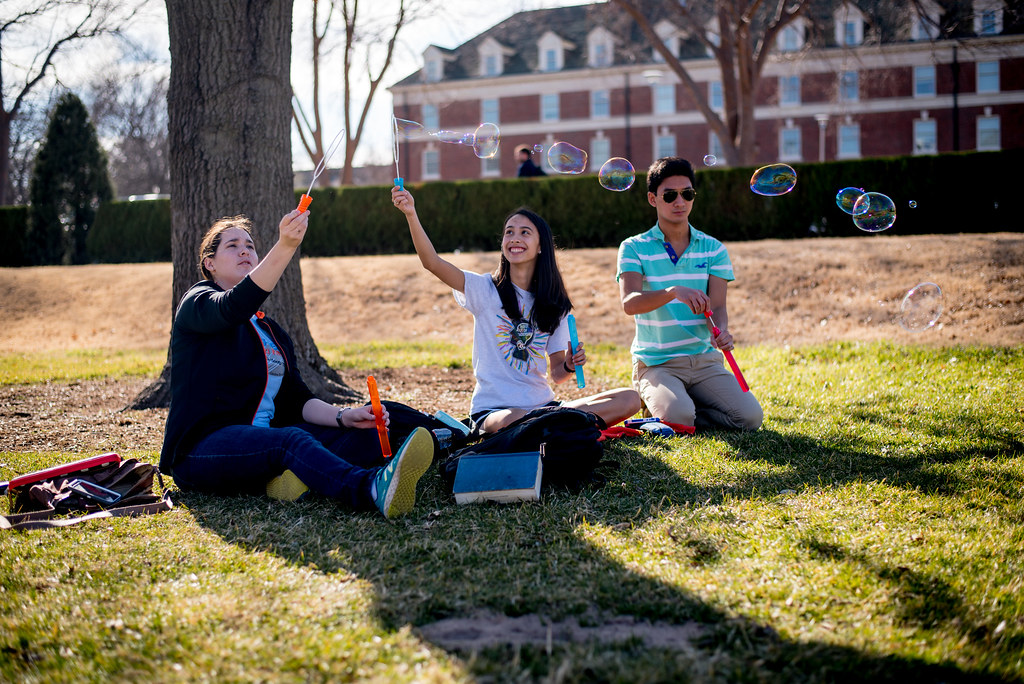
I’ve said it before and I’ll say it again, I really like working on a college campus. While most days are fairly ho-hum, there’s always the chance that you will run across an interesting photographic opportunity if you have your eyes open and your camera handy. When I took this photo I just happened to be walking across campus on an errand and had my camera handy, and I came across this trio of students enjoying the nice mid-February weather in a way that I don’t think I would ever see in corporate America. Something about this scene struck me as uniquely post-secondary: books, backpacks, bubbles, and a fierce refusal to care what anyone else might think. I walked past these students initially and then thought to myself “Why don’t I go take their picture?”

The answer to that question was the same as it usually is, and involved silly excuses like “What if they don’t want me to?” “What if they think I’m some kind of creepy weirdo?” “What if I don’t know how to frame the shot and I get a bad picture?” Fortunately my curiosity got the best of me and I turned around, walked back to where they were sitting, and asked if I could take their picture. They seemed to be flattered and I told them that blowing bubbles on a sunny day is something my kids like but I don’t usually see older people doing and that seemed to help erase any tension they might have had. Honestly my first priority was to just put these students at ease and let them know that I had no ill intentions (not that they had any cause to believe so in the first place, but still…) and then snap a few pictures. A lot was racing through my head as I crouched down and fired off a few shots such as:

• What should I focus on?
• What f/stop should I use to get the right depth of field?
• How should I frame these students to get a good shot?
• Where should I shoot from to make the best use of available light?

I didn’t have time to really ponder and explore these issues, but I think over the years I’ve built up enough instincts to get a few things correct right off the bat. The girl in the middle seemed to be really getting into the moment so I knew I wanted her sharp and in focus, and I shot with an aperture of f/2.4 which in hindsight was probably a bit overkill. It did give me a nice depth of field so the subjects are clearly pulled out from the background, making it easier to draw the viewer’s attention to them. But honestly my main goal wasn’t technical in nature but more compositional. I wanted a way to really capture the joy and delight of these students, and seeing the gleeful smile on the girl’s face as she watches bubbles float away from her wand does precisely that.

I’m very happy with the micro-composition elements of this picture too. The bubbles stream across the frame but do not overlap with the male student or the passer-by in the background. The girl on the left is framed nicely within the tree. And even though the horizon line cuts right through the head of my main subject (something I try to avoid whenever possible) the tradeoff was, in my mind, well worth it.

I took about eight or nine pictures, thanked the students, and went on my way not sure if I got anything useful at all. Even though I did get what I think is a good picture, at the time I didn’t even care since I just enjoyed seeing a very tangible reminder that there is always warmth following winter and light after dark, and no one should ever keep us from celebrating it.

Read my educational photography articles at Digital Photography School

First Signs of Spring

March 16, 2016 10 Comments

First Signs of Springhttps://www.weeklyfifty.com/wp-content/uploads/2016/03/WeeklyFifty2016March16FirstSignsOfSpring.mp3

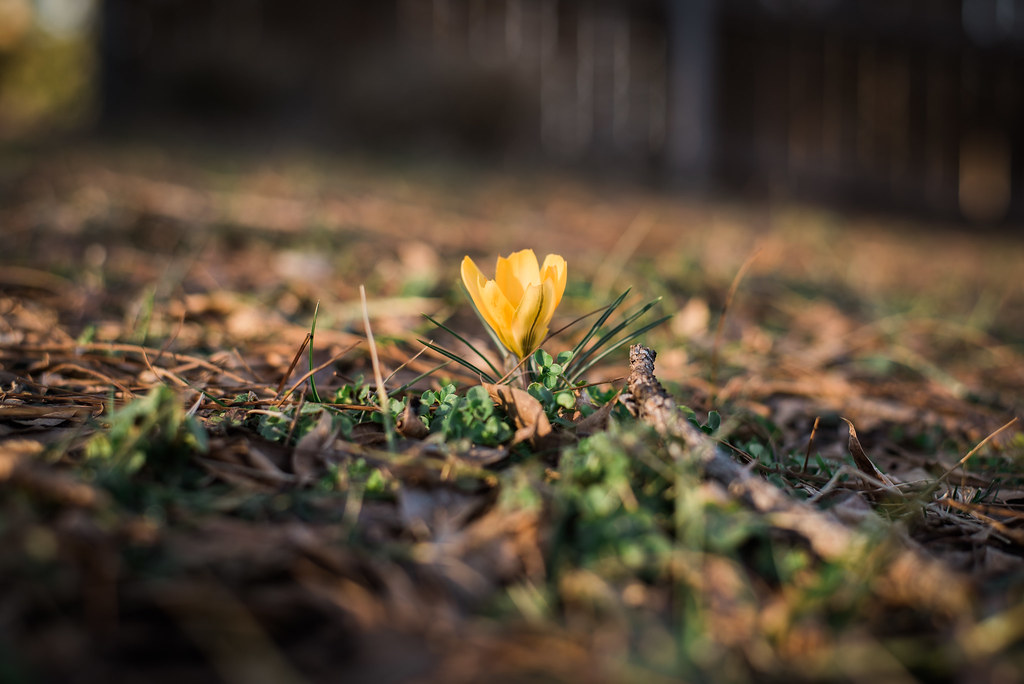
If this picture seems a bit familiar to you, it’s probably because you might have seen similar photos here on Weekly Fifty around this time of year. However, just like last week’s image this is more about process than product, and what it represents to me is more important than the picture itself. One of the best things about using a camera is that it forces you to see the world around you in a bit of a different light. If I have my camera on me, preferably in my hand or around my neck (yay Black Rapid!) I’m constantly looking at things a bit closer, or from a different perspective, or just stopping to take in the world around me when I would otherwise just be walking on by. Case in point: the image you see here. One of the best parts of spring is the tangible ways in which you can see the world reawakening and coming to life after winter, even a relatively mild one like we have had this year in Oklahoma. Dry tree branches, brown patches of grass, and dirt-laden flowerbeds slowly turn to color as the world shifts from grey to green, and looking at all this through the lens of a camera really can be quite fascinating.

Almost every year one of the first signs that spring is on its way is the appearance of crocuses in our yard, and I happened to see this one when I was outside playing with my kids on an afternoon in mid February. I don’t even remember what the three of us were doing but I think my wife was working on revising an article to submit for publication so I took the boys out to…who knows. Does it even matter? We were outdoors probably playing hide and seek, digging up the front yard, maybe climbing trees, or some other such activity that is not all that conducive to the chilly months of winter. My oldest son saw this flower and asked if he could pick it, and I said yes but asked him to hold off just a few seconds while I snapped a picture. You can’t tell from the image but he is literally standing just a few feet away right out of the frame waiting for daddy to finish messing around with the camera, after which he and my other son came right over and investigated this little yellow slice of nature a bit more closely.

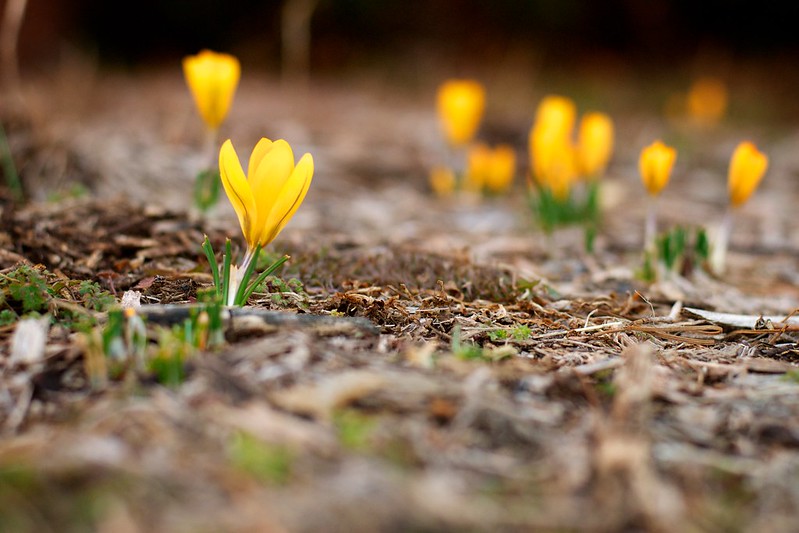
In taking the photo several questions ran through my mind: what aperture to use for the depth of field I wanted? How close do I get to frame it like I want? What angle do I shoot at to get the desired composition? In a sense this picture is a tangible representation of my developing thought process over the past few years of taking pictures. It’s kind of a spiritual successor to this one that I took in February 2013:

Crocuses

Back then I usually approached a photo with the mindset of “BOKEH BOKEH BOKEH!!!” and the result was (and sometimes still is, if I catch myself off guard) a bit clumsy and distracting. While I do like the sense of context in the original photo with additional flowers receding into the background, the thin depth of field makes for an unpleasant composition overall. The colors are also over saturated with highlights that are far too bright, but photography is nothing if not an iterative process and this week’s image is a bit of evidence to prove it. There is always something new to learn, and if you ever feel as though you’ve reached the point at which you don’t think you can grow any more as a photographer it might be best to find yourself a new hobby.

Read my educational photography articles at Digital Photography School

  • « Go to Previous Page
  • Page 1
  • Interim pages omitted …
  • Page 112
  • Page 113
  • Page 114
  • Page 115
  • Page 116
  • Interim pages omitted …
  • Page 146
  • Go to Next Page »

Copyright © 2026 Creative Commons License
This work is licensed under a Creative Commons Attribution-NonCommercial-NoDerivs 3.0 Unported License.