• Skip to main content

Weekly Fifty

Exploring the wonders of creation through a 50mm lens...and other lenses too.

  • Subscribe
  • YouTube
  • About

Droplet

June 11, 2015 2 Comments

Droplethttps://www.weeklyfifty.com/wp-content/uploads/2015/06/WeeklyFiftyPodcast2015June10Droplet.mp3

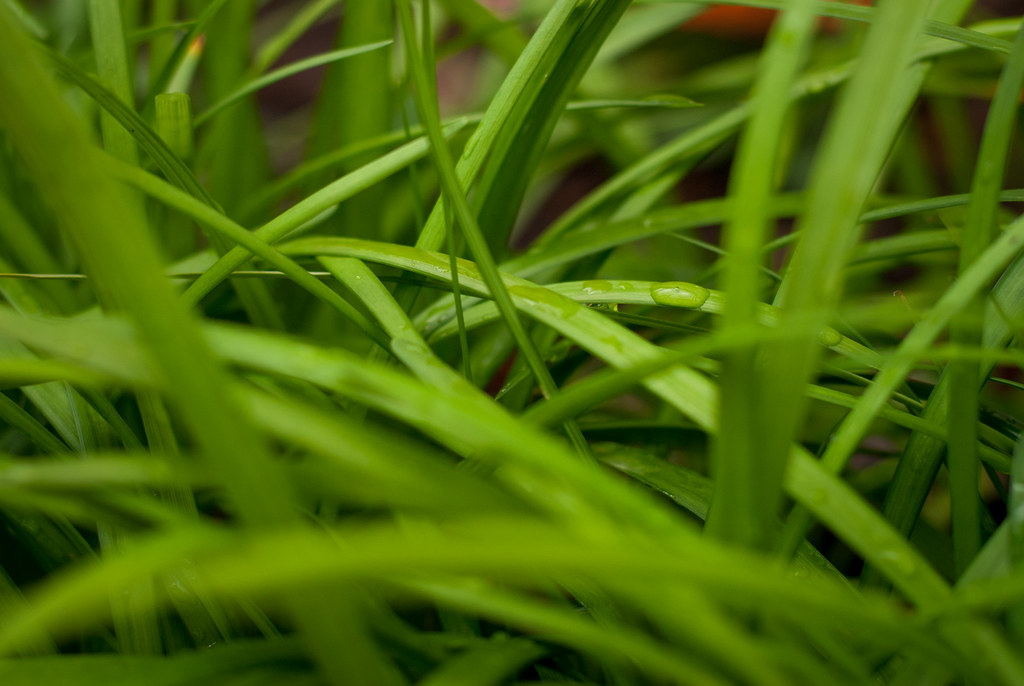
I realize this picture is quite similar to one I posted a long time ago, but I’m using it for this week’s image specifically to make a point about my thought process when deciding which pictures to upload to my online Flickr portfolio and then feature here on Weekly Fifty (not all of which make the cut). It’s sort of a case study analysis, so to speak, partially to illustrate how my approach to photography has changed over the years but also to help others who might be wondering how to change their approach to photography too.

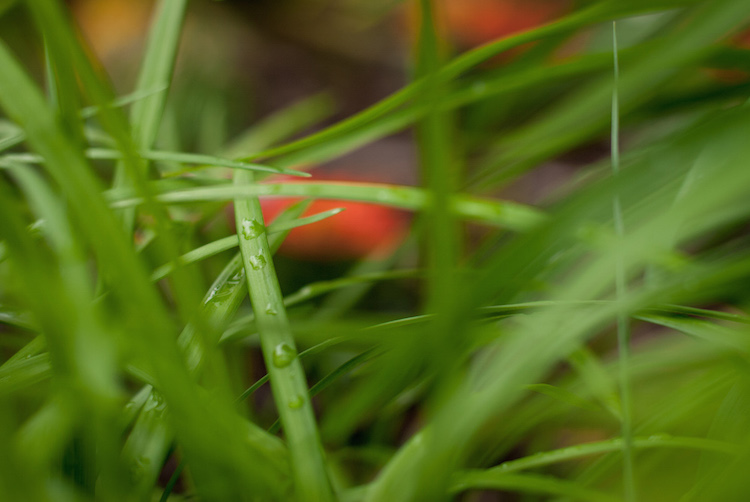
What you see above is relatively simple: a drop of water in a patch of grass. There’s a very monochromatic black-and-green color palette and not a lot of things going on, but I want you to compare it to a similar picture I took in the same location a few minutes later:
DSC_2683-750

The two images are remarkably similar, and the second one was originally going to be the subject of this week’s blog post. But after a little thought and analysis I settled on the first one and I thought I’d take a minute to explain why.

One of the things I like to keep in mind when photographing is the question “What do I want the viewer to see/think/feel?” In this case I was not trying to impart any special message or feeling, but rather have the viewer notice a simple drop of water on a blade of grass. Even though both images do that, the second one has a bit too much going on and actually becomes a bit of a mess. The focal point of the second image is the drop on the top of the blade of grass, and once you see that you might notice other things as well: additional drops of water, the surrounding blades of grass, or the (blurry) red flower in the background. This was good, I thought, because it gave the image more depth: it’s actually a lot more than water on grass, and that’s a good thing.

Right?

Not really. The more I looked at the picture the more I realized there was actually no focal point and instead there was a confusing mess. What was it I was trying to get my viewers to see? Was it a single drop of water, or many drops of water? The red blob in the background became distracting, and the foreground elements (some of which are on the left, some on the right) divided the viewer’s attention. Instead of being about one clear thing the photo was about many unclear things.

Even though the picture on top had less color and less going on it was actually far more pleasing to the eye and, in my view, more interesting overall. There is one clear focal point: the single drop of water. That gives the viewer something much more concrete and tangible on which to focus his or her attention, and a more pleasing sense of place and context as well. The foreground is not as cluttered and there is nothing in the background to divert the viewer’s attention. It’s simpler but, in my opinion, a much better image.
Read my educational photography articles at Digital Photography School

Hello there

June 3, 2015 9 Comments

Hello therehttps://www.weeklyfifty.com/wp-content/uploads/2015/06/WeeklyFiftyPodcast2015June3HelloThere.mp3

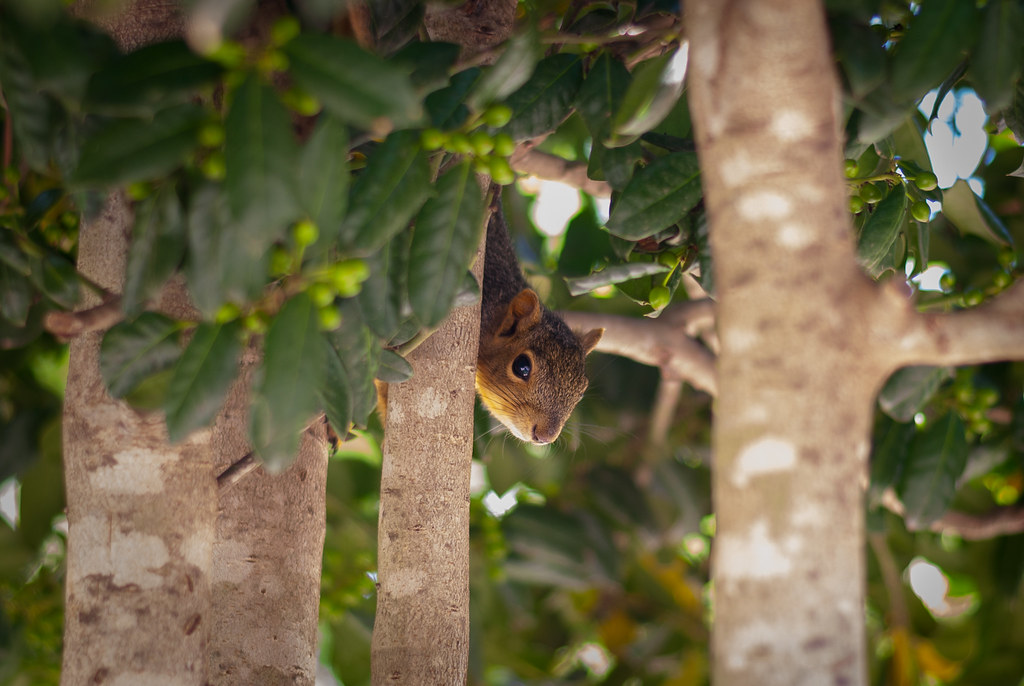
This is one of the most unique examples of photographic serendipity I have collected in my personal portfolio, and I still can’t believe it actually worked out. I was out shooting a few pics for a Digital Photography School article on using the Program Automatic mode on a DSLR camera when I came across this skittish squirrel running up and down a few small trees. I watched him dash up this young magnolia tree, seeking sanctuary from a pair of furious mockingbirds nearby, and waited a few minutes to see if he would come back down. A bit later I saw him poking his head out of the tree canopy so I raised my camera, focused, waited a bit more until he crawled a few more inches down to have a look around…and quickly fired off one single photo. I don’t know if it was the sound of the shutter or a sense that the mockingbirds were not going to leave him alone, but he immediately dashed down and ran off to another tree close by.

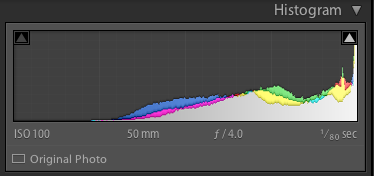
Much to my dismay when I peeked at the image on my viewfinder I realized it was a total loss. The image was way overexposed because the aperture closing mechanism on my lens jammed (an occasional problem I have thanks to dropping my camera on a concrete floor a year ago) and one look at the histogram convinced me it wasn’t even worth trying to salvage:

Original image. Ouch.
Ouch.
And the histogram. Double ouch.

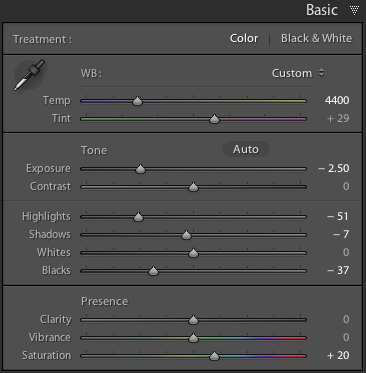
A while later I came back to the photo and figured I might as well give it a shot and see what could be done. Much to my surprise there was enough color data captured in the RAW file to do quite a bit. Lowering the exposure 2.5 stops, dropping the highlights, and a few other edits later (as well as some tweaking with the adjustment brush) resulted in a photo that was not only quite usable, but not that bad overall.

Lightroom to the rescue!

The most important takeaway from this is one I keep coming back to: shoot in RAW! Storage space is cheap, and you never know when all that extra data might come in handy. Incidentally this was a 12-bit (not 14-bit)  RAW file, and I know there’s a lot of debate over which one is better, but seriously…if I can salvage this much from a 12-bit RAW file (taken with a 10-year-old, 10-megapixel Nikon D200) I don’t see any reason to shoot in 14-bit.

Alright, enough techno jargon. If you’ve read this far, time to shut ‘er down, grab your camera, and go out there and take some pics! You never know what you might end up with :)

ps. The title of this week’s photo is a nod to Star Wars Episode IV when Obi-Wan meets R2-D2 for the first time. I imagine whatever was going on in the mind of this squirrel is similar to whatever was passing through the circuits of our favorite little R2 unit–the blue one with a working motivator :)

Read my educational photography articles at Digital Photography School

Dead Week

May 27, 2015 4 Comments

Dead Weekhttps://www.weeklyfifty.com/wp-content/uploads/2015/05/WeeklyFiftyPodcast2015May27DeadWeek.mp3

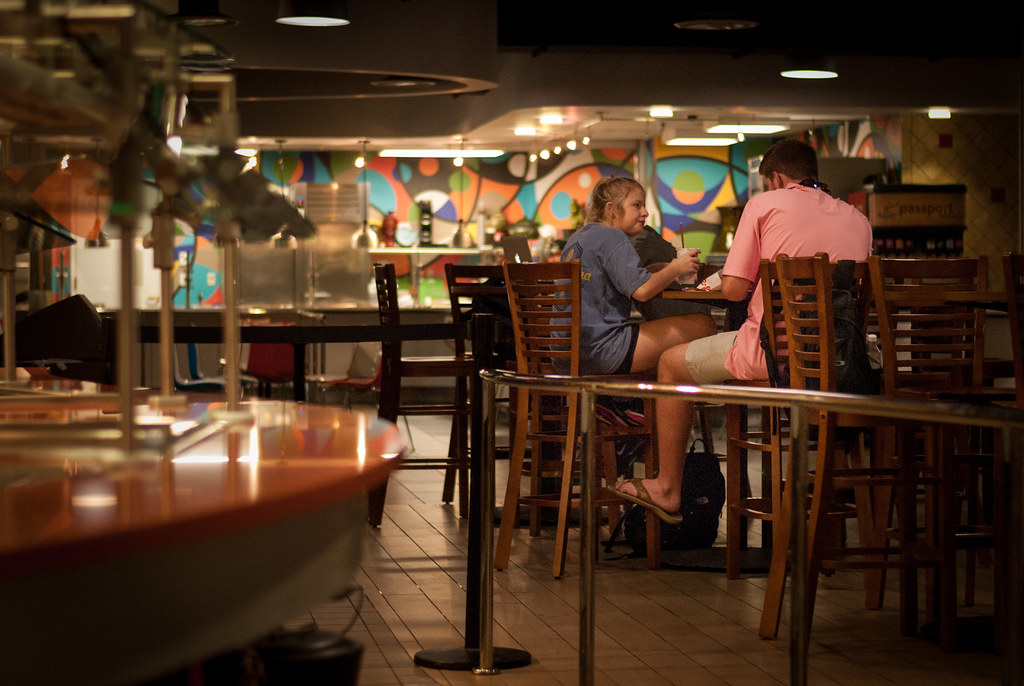
This is another picture that was directly inspired by my brother Tom, and it was actually based on a promise I made to him several months ago. We were talking about taking photos in public and I told him how I get nervous when photographing strangers because I don’t want to make anyone uncomfortable. His reply was simple: “Dude, they probably won’t even notice you. And if they did, they probably wouldn’t care.” He had a good point, and I told him I would go to the Student Union on campus and deliberately take photos of people to try to get over my public photo phobia. This, then, is a direct result of our conversation.

I took several pictures while I was walking around at the Union, some closer to people and some farther away, but Tom was right: nobody so much as batted an eye. And come to think of it, I probably wouldn’t either if some dude came around snapping photos in a public place like that. This one is my favorite of the bunch because it’s got a lot going on, with the two students serving as the main focal point. There’s a few empty warming areas on the left, some kind of eatery in the background, and enough chairs to give the sense that this is normally a busy place. The two students are clearly eating and hopefully enjoying each other’s company, but the backpack on the floor (and what looks like another one on the table behind the girl) gives a clue that this is a college campus and not a mall food court. In essence, it’s another reminder of the importance of context and how everything other than your subject can add just as much to a photo as the subject itself.

I made the deliberate choice to shoot at ISO 800 even though that can be somewhat grainy on my old Nikon D200, and f/1.8 in order to get a bit of foreground and background blur. Also, a bit of clarification about the pic: it was not technically dead week when I took it, but the scene reminded me of something you might see on any college campus during the last five days of class before finals.

Read my educational photography articles at Digital Photography School

Going Up

May 20, 2015 6 Comments

Going uphttps://www.weeklyfifty.com/wp-content/uploads/2015/05/WeeklyFiftyPodcast2015May20GoingUp.mp3

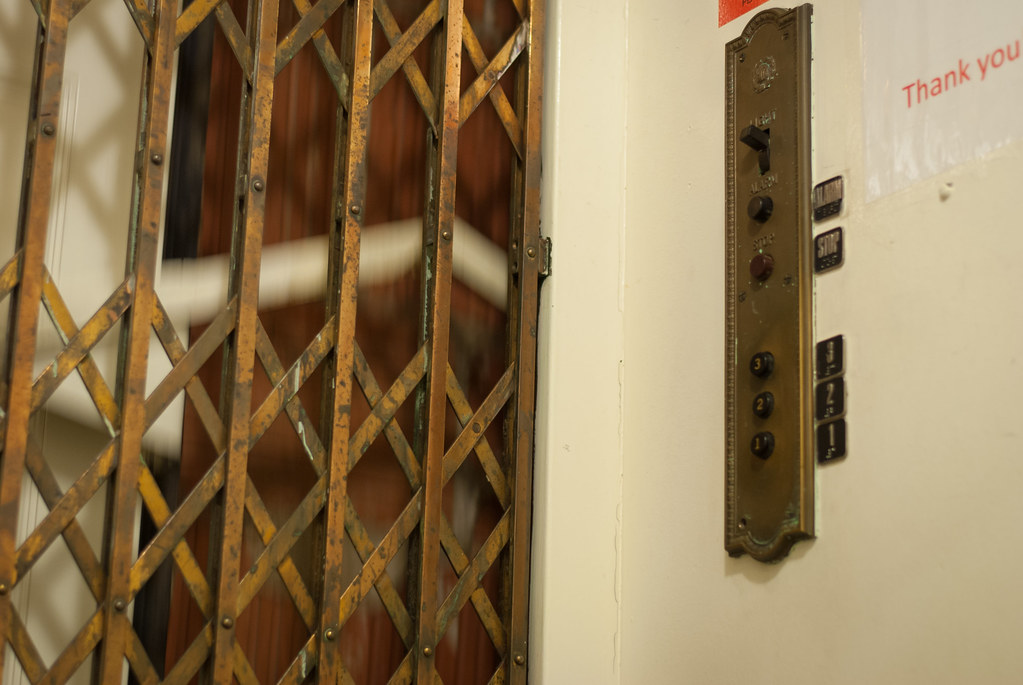
This is a variation on panning, a technique I have explored before here on Weekly Fifty and continue to enjoy practicing whenever possible. But this time I switched it up a bit and tried something a bit different. First, a bit of background: the elevator in my building on campus is so old it’s listed on some kind of obscure historical registry. It’s not the most convenient transportation mechanism, but it does feel a bit like you’re stepping back in time when you set foot inside it. To enter you have to first open a massive door and then slide a collapsible gate which you can see here. The elevator won’t move unless both doors are closed, which causes problems if someone gets off the elevator and forgets to shut the inner gate, leaving would-be elevator riders on all other floors stranded. Some might say this old wreck needs to be replaced, while others would likely respond that it merely adds a touch of character to our building. I’ve worked here almost two years and I’m not quite sure where I fall along that spectrum just yet :)

I’ve often thought about how I could capture a bit of the essence of this elevator with my 50mm lens, but one problem its that the field of view is so narrow its usefulness is severely hampered in small spaces like a six-by-five-foot lift. I’ve taken a few snapshots of the mechanical buttons, but that never seemed to do justice to the, um…essence of the elevator. A few weeks ago it finally hit me: why not try a shot while it’s actually moving? I shot this in the morning before anyone else was in my building, and rode it from first to third floor a few times while snapping a lot of pics at f/1.8, 1/20 second, ISO 200. With no tripod I had to shoot this handheld, so of several dozen shots only two or three were clean enough to clearly show the buttons and demarkations on the side. I have since thought about going back and re-shooting it with a tripod but I’m pleased with the photo itself and would rather try other shots based on what I learned here than go back and re-create something similar just to get it a tiny bit more sharp.

My goal in this pic was to not only show the buttons (which give a sense of how old this thing is) but the gate and the passing innards of the building itself. It’s just not something you see everyday, and while a static shot would have likely sufficed I thought it was cool to get a sense of motion to help the viewer feel as though he or she is actually riding this rickety rush bucket. I mean, classy work of engineering.

Read my educational photography articles at Digital Photography School

Morning Fog

May 13, 2015 10 Comments

Morning Foghttps://www.weeklyfifty.com/wp-content/uploads/2015/05/WeeklyFiftyPodcast2015May13MorningFog.mp3

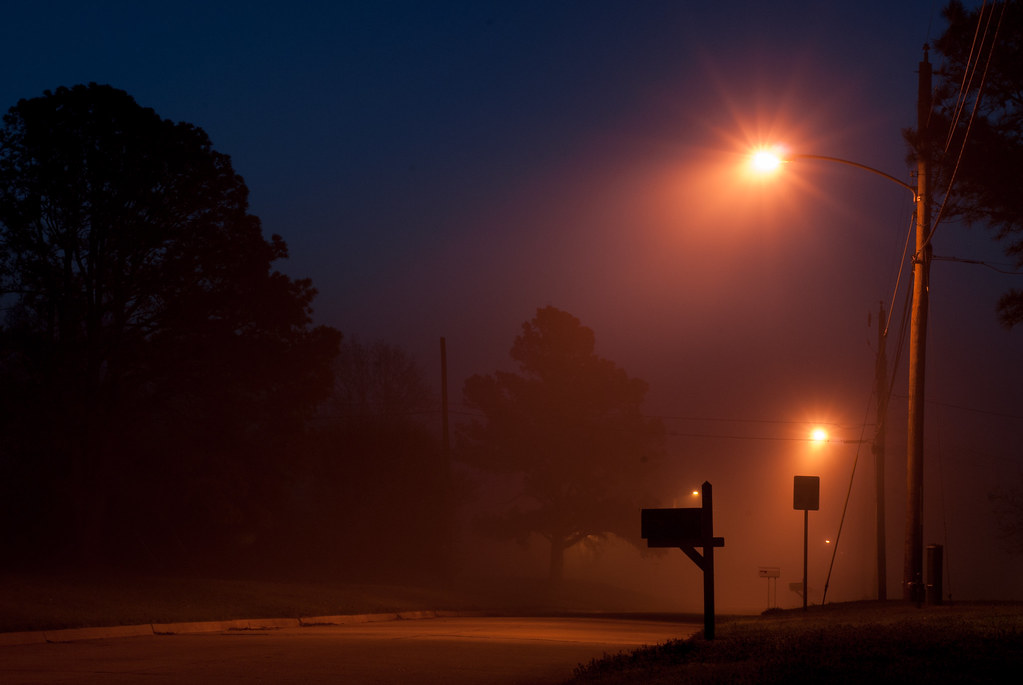
I looked outside one morning a few weeks ago to discover the whole neighborhood covered in a thick blanket of fog, so of course my first instinct was to run grab my camera and tripod. If you have never shot in fog before I highly recommend it, as the diffused light makes even familiar locations seem downright otherworldly. This was taken about 6:30am which meant the sun was not quite on the horizon yet, but there was just enough light way, way off in the distance to lend a bit of color to the sky. Unfortunately I did not have much time to work because my kids were going to be up soon so all I could do was shoot from a few locations in my front yard. Because of that there are a few elements in the scene that I could do without–ideally I would have just the mailbox in the foreground with none of the background objects like signs or additional mailboxes. But that’s what photography is all about: making the most of your limitations.

Thankfully there was almost no breeze so all the trees were perfectly still, which meant I could get a nice long exposure of 15 seconds at f/16, ISO 200. I shot one or two at wider apertures but liked the star patterns of shooting at f/16, and the diffusion of the fog came out just how I was hoping. I was also pleased with the background lights, including one behind the tree in the middle that creates an almost cinematic backlit effect. Most of this was entirely unintentional since the only thing I was really hoping to capture was the the light in the foreground and the trees on the left, but it was kind of cool to pick up on some of the extra elements as I edited this image in Lightroom.

Read my educational photography articles at Digital Photography School

  • « Go to Previous Page
  • Page 1
  • Interim pages omitted …
  • Page 115
  • Page 116
  • Page 117
  • Page 118
  • Page 119
  • Interim pages omitted …
  • Page 141
  • Go to Next Page »

Copyright © 2026 Creative Commons License
This work is licensed under a Creative Commons Attribution-NonCommercial-NoDerivs 3.0 Unported License.