• Skip to main content

Weekly Fifty

Exploring the wonders of creation through a 50mm lens...and other lenses too.

  • Subscribe
  • YouTube
  • About

Winter Leaf

February 25, 2015 6 Comments

Winter Leafhttps://www.weeklyfifty.com/wp-content/uploads/2015/02/WeeklyFiftyPodcast2015February25WinterLeaf.mp3

Here’s another photo that not only came about due to sheer serendipity and, as it turns out, a massive blunder on my part. I had my camera with me as I went to work, and before I got to my building I saw some leaves frozen in a puddle. No big deal, right? Still, I figured I might as well try for something so I got down low and took a few shots. Then I figured I would just go for broke and just lay prone on the grass by the puddle and take a few more photos. As I’ve mentioned before I am more than a bit self-conscious when it comes to taking pictures where (gasp!) someone might notice, but it’s something I am determined to overcome. So there I am, lying face first on the ground taking photos of leaves, and you know what? I really enjoyed it. But when I loaded the pictures in Lightroom I discovered that my favorite of the bunch was massively overexposed. Way bummer, right? I lowered the exposure by a stop and a half, decreased the highlights by 100, shook my head in dismay, and closed Lightroom.

A few hours later I returned to the photo and was pleasantly surprised that I actually liked what I saw. Even though it did not fit what I was originally aiming for, I liked how the leaf now looked like it was covered in a light frost. What you see as frost is actually missing data that was clipped out due to the overexposure, which I actually like. I toyed with a few other color adjustments before tossing it up to the ol’ Flickr page, and it makes me wonder what other creative uses there are for intentional over- or under-exposure. Hmm…

On a side note, many people say (and to an extent I agree with them) that Electronic Viewfinders are the future for cameras because, among other things, they let you see exactly what the final photo will look like. If I had been using a mirrorless camera with an EVF on this particular morning, I would have never gotten this shot.
Read my educational photography articles at Digital Photography School

Transportation

February 18, 2015 12 Comments

Transportationhttps://www.weeklyfifty.com/wp-content/uploads/2015/02/WeeklyFiftyPodcast2015February18Transportation.mp3

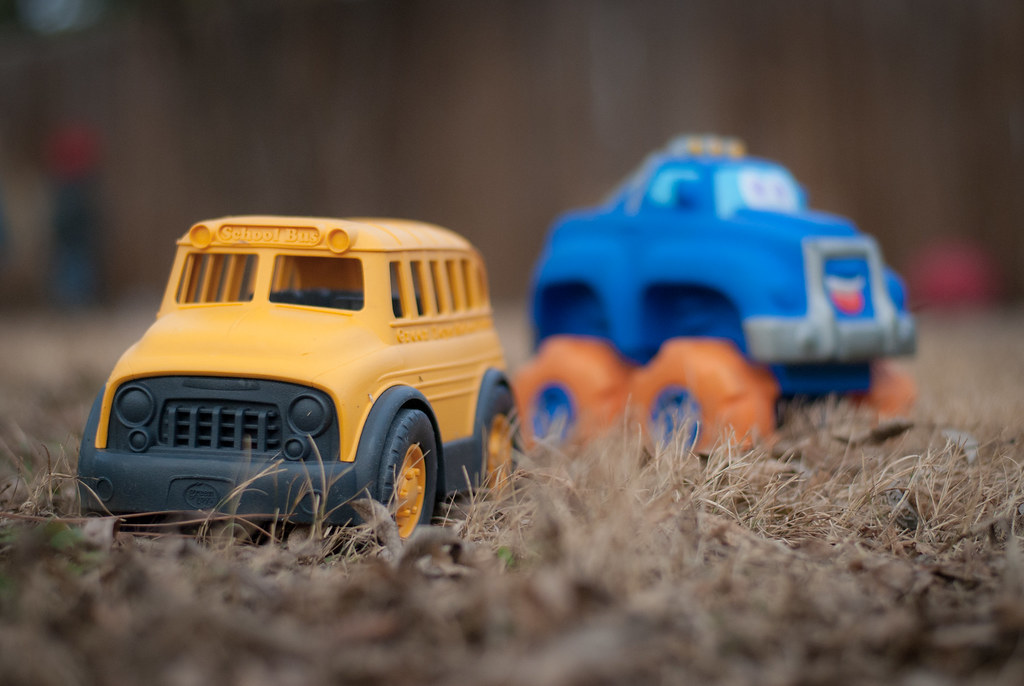
Sometimes when people tell me they don’t have any interesting subjects of which to take photos, I suggest that they go out and see what they can find in their very own back yard. This photo, while not especially stellar or noteworthy, was the result of just such an experiment: I was out back playing with my kids who had brought a few of their toys along with them. When I saw the bus parked next to the monster truck I thought it might make an interesting picture, so I laid down on the ground and snapped a few pics. To be fair I did adjust things a big, moving the blue truck and repositioning the bus just a hair so I could get the look I wanted, but the idea itself was a result of simple serendipity. I was a couple feet away from the bus shooting wide open at f/1.8 at ISO 400, though given the resulting shutter speed (I shot this in Aperture Priority) of 1/3000 I suppose I could have easily lowered the ISO to 200 or 100 to get a cleaner shot. But as it is, I’m pleased with the result and enjoyed seeing, once again, that you don’t have to go far to find something interesting to photograph.

Read my educational photography articles at Digital Photography School

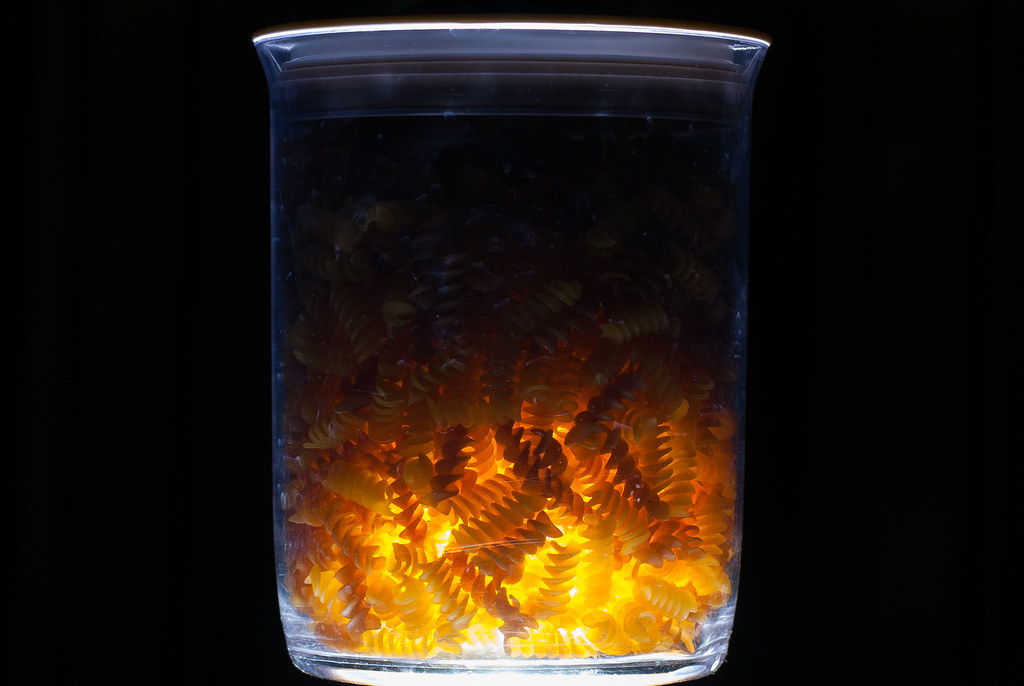
Pasta Fire

February 11, 2015 20 Comments

Pasta Firehttps://www.weeklyfifty.com/wp-content/uploads/2015/02/WeeklyFiftyPodcast2015February11PastaFire.mp3

If you read this blog with any regularity you know that most of the pics I post are of existing scenes and objects, with very little manipulation on my part. But this time I wanted to try something a bit different and create a scene specifically to be photographed. And though the overall concept was, I believe, a success, I am not particularly happy with the picture itself for a couple reasons I’ll get to in a bit. However, to me this is more of a proof-of-concept than a photo of which I am genuinely proud, and I hope to try this sort of thing a bit more in the coming months.

I was in the kitchen the other day and as I picked up a jar of pasta I thought it might make an interesting photograph if I could get the lighting right. I realized I could balance the entire jar on top of a flashlight, which meant the only tricky part would be finding a time to actually take the picture. The next morning I got up early, set the jar on the flashlight, positioned my camera on a tripod, and took a few shots. The light was so bright that a long exposure of eight seconds illuminated too much of the pasta, so I shortened the shutter speed in successive shots until I got what I wanted. This particular picture was a three-second exposure at f/4.8 and ISO 100, and I had to clean up dozens of smudges and fingerprints on the jar in Lightroom as well as bring out a bit of the shadow detail and some other minor adjustments. All in all it was a fun experiment, and as my coworker Gina suggested, maybe I could try filling the jar with other objects and see what happens when they, too, are lit from below. Hmm…so many possibilities… :)

Read my educational photography articles at Digital Photography School

Ascendance

February 4, 2015 Leave a Comment

Outlookhttps://www.weeklyfifty.com/wp-content/uploads/2015/02/WeeklyFiftyPodcast2015February4Ascendance.mp3

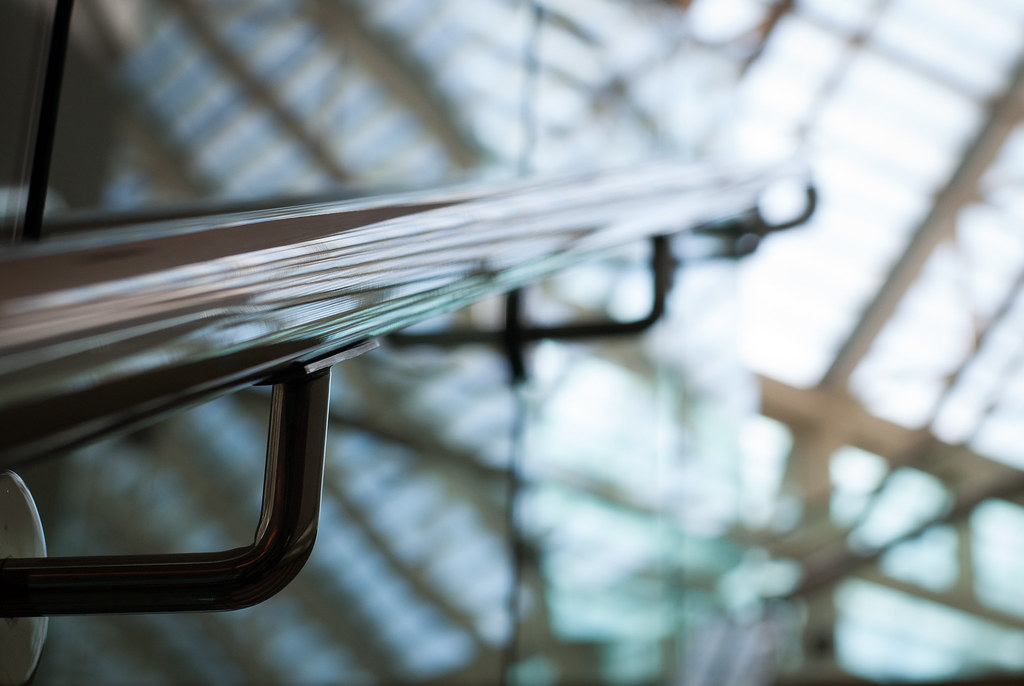
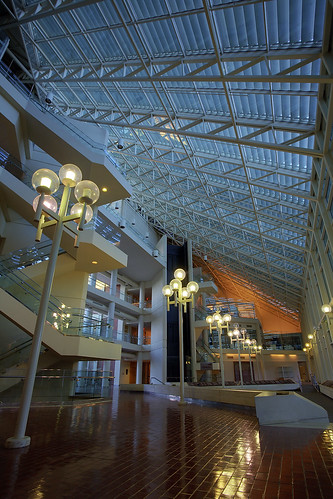
One of the architectural features of Oklahoma State University is the Noble Research Center, which I have walked past many times but never actually visited until recently. The south face of the building is dominated by a series of massive louvers which serve to create a fantastic sense of open space and scale in the inner lobby which makes the building ideal for photography. All the light and shadows playing off the various features inside work together to create an environment with so many photographic possibilities it’s difficult to know where to start. Unfortunately with a 50mm lens on a crop sensor camera, it’s a somewhat tricky proposition to capture the sense of grandeur and open air that is better suited for a much wider lens. I tried a few shots just looking up at the roof but those didn’t work at all, so instead I figured I would focus on one of the metal stair railings as a way of giving a bit of context to what would otherwise just be a photo of the ceiling.

I kind of like how the initial focus of the viewer is on the lower left, and then the eye should (in theory, anyway) follow the railing up to the top-right as a way of exploring the scene a bit. I shot this at f/4 to give a somewhat shallow depth of field, and there was so much light coming in that I was able to use ISO 200 to get a silky smooth image with virtually no noise at all. I think my favorite aspect of this image is that it introduced me to something new that has been right in front of my eyes for years, and in doing so kind of inspired me to seek out more of what OSU has to offer in the coming months.

Read my educational photography articles at Digital Photography School

Split Second

January 28, 2015 7 Comments

Split Secondhttps://www.weeklyfifty.com/wp-content/uploads/2015/01/WeeklyFiftyPodcast2015January28SplitSecond.mp3

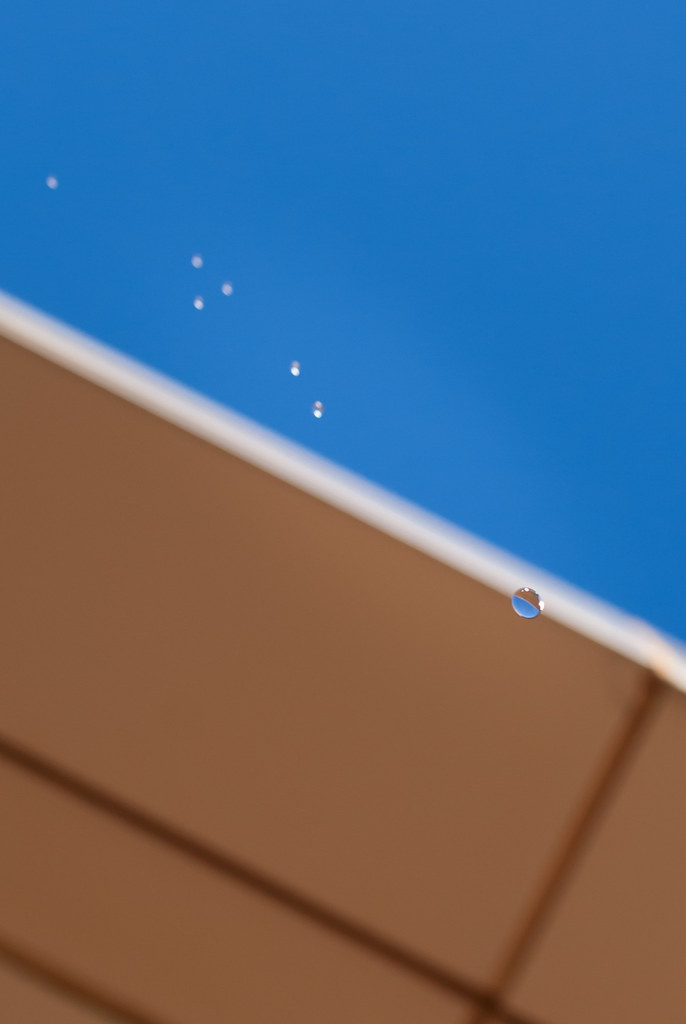
Sometimes I wonder when I will ever learn. Here’s yet another example of a picture I really like that came about purely by chance, and only because I took thirty seconds to pull out my camera and actually attempt the shot. I was walking out of a building the other day when I saw some big fat drips falling from an overhang, and nimbly sidestepped them as they splashed on the pavement. And that was that–no second thoughts given on my part, and a good photo opportunity nearly missed. But then I thought I would try, just try, to catch one of the drops as it was falling. I am horrendously self-conscious when it comes to taking photos, and because a) it’s something I’m working on, and b) no one else was around, I knelt down and aimed my camera right up into the path of the drips. No way was autofocus going to work, so I put my camera in manual, set the aperture to f/4 and ISO to 200, and just motor-drove until the buffer was full (which, thankfully, is over 20 RAW shots on my D200–three times the buffer size on my D7100 even though the latter is a newer and much more expensive camera). I kept scooting around on my knees with my camera aimed skyward hoping everything would line up for a good shot, and out of 43 images this was the only one in which the main drop of water was in focus. But wow, I sure am pleased with the results. I like the trail of smaller drops off to the upper-right, and decided to use a vertical orientation as opposed to my traditional horizontal style because it seemed to fit the mood of the picture better. I was also pleased with how the big drop perfectly inverts the colors of the overhang and the sky, and overall this required very little retouching in Lightroom.

Maybe one of these days I’ll stop worrying about what other people think, and just learn to be that weirdo with the camera who is always taking pictures of things. And like my brother Tom says, chances are no one will even notice, so why even give it a second thought :)

Read my educational photography articles at Digital Photography School

  • « Go to Previous Page
  • Page 1
  • Interim pages omitted …
  • Page 118
  • Page 119
  • Page 120
  • Page 121
  • Page 122
  • Interim pages omitted …
  • Page 141
  • Go to Next Page »

Copyright © 2026 Creative Commons License
This work is licensed under a Creative Commons Attribution-NonCommercial-NoDerivs 3.0 Unported License.