• Skip to main content

Weekly Fifty

Exploring the wonders of creation through a 50mm lens...and other lenses too.

  • Subscribe
  • YouTube
  • About

Color Pool

January 21, 2015 Leave a Comment

Color Poolhttps://www.weeklyfifty.com/wp-content/uploads/2015/01/WeeklyFiftyPodcast2015January21ColorPool.mp3

I look at this photo and still can’t believe it almost didn’t happen. Not that this picture is anything special really, but I do kind of like it and the cornucopia of colors swirling in the puddle–augmented by the leaf stem sticking up on the right-hand side almost like a punctuation mark on the whole scene. But when I shot this I was walking to my office about 9am on a dreary December morning and noticed a puddle right next to where I took a photo of some mushrooms a few months ago. It was cold, rainy, and though I had my D7100 + 50mm lens with me I was not really in a picture-taking mood. I just wanted to get inside and warm up, but a little voice over my shoulder told me to pause, set down my backpack (because briefcases are way lame), and just take a photo already. So I knelt down on the soggy grass and got to work.

I knew right away I wanted to use the leaf stem as a compositional element, but was not sure exactly how to use the rest of the photo to frame it. I shot a few pics with the leaf on the left-hand side, but it just wasn’t working out how I hoped. The colors weren’t as vivid, and I didn’t like the direction of the leaf stem–it was almost as if it was directing the viewer to gaze off the left-hand side of the picture. So I recomposed the shot (manually focusing again, because I didn’t quite trust the autofocus to nail the tip of the leaf stem) and was much happier with the results. And, as you might have predicted after listening to last week’s audio, I shot this at f/2.8 to make sure the DOF wasn’t out of control :)

The biggest challenge here was actually the editing. With so many buttons and sliders available in Lightroom it can be easy to go overboard, but I wanted to keep things reigned in while still getting a nice vivid image. Prior to editing the picture looked far too dull and lifeless, but that’s why I shoot in RAW: to have enough color data available to make the final image represent what I actually see in real life. Initially I had it way over-saturated, way over-contrasted, and even gave in to the temptation of Clarity Overload, but realized yet again that less is more, and finally settled on the version you see here.
Read my educational photography articles at Digital Photography School

Signs of Life

January 14, 2015 7 Comments

Signs of Lifehttps://www.weeklyfifty.com/wp-content/uploads/2015/01/WeeklyFiftyPodcast2015January14SignsOfLife.mp3

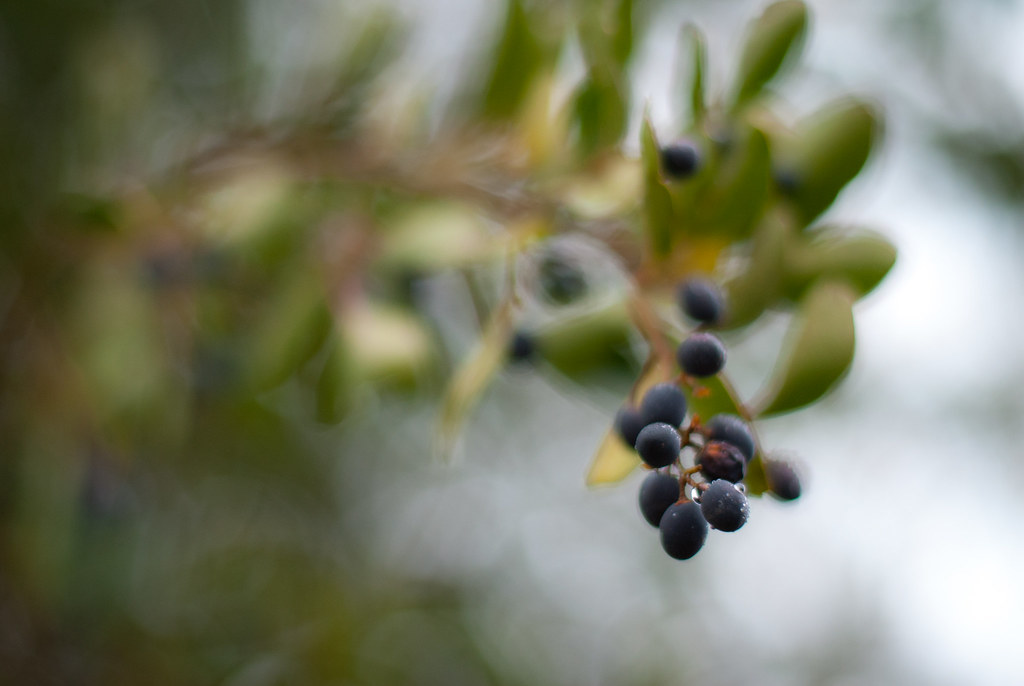
Originally I had not planned on posting this photo, but the idea came to me while recording the audio for last week’s image because I realized it functioned as a sort of companion to the Yucca Tails. It is similar in composition with the focal point being on the right-hand side, which then serves to draw the viewer’s eye back into the rest of the picture to see what else is present. In this case it’s a clump of purple…um…somethings (seeds? berries? I honestly don’t know, even though this is a tree in my very own backyard) instead of the branches of a yucca plant, but overall the sentiment is quite similar. It also has echoes of a photo I posted several months ago called “After the Rain,” and in fact I used some of the techniques I learned when shooting that as I captured this image. Perhaps it’s an unconscious stylistic choice, but I rather like this type of composition, even if some people might call it derivative.

The reason I decided to post it here is to function as somewhat of a cautionary tale regarding shallow depth of field. Since the sky on this breezy day was quite overcast and I was using my D200 at ISO 200 (I suppose in retrospect I could have just bumped it up to 400) I needed to let in as much light as possible in order to freeze the purple berry-thing in front. That meant using f/1.8, which I don’t often do because, well, as you can see the depth of field is, in my opinion, a bit too much. The bokeh almost distracts from the subject, and it borders on overpowering–particularly the green leaves just above and to the right of the deep violet subject. F/1.8 is great to have when you really need it, but in this case I think I should have just found a way to get the shot with a little less DOF. Still, I’m happy with the image overall and I think it’s high time I figured out just what this tree/plant/bush/whatever actually is that’s been behind our house ever since we bought the place :)

Read my educational photography articles at Digital Photography School

Yucca Tails

January 7, 2015 5 Comments

Yucca Tailshttps://www.weeklyfifty.com/wp-content/uploads/2014/12/WeeklyFiftyPodcast2015January7YuccaTails.mp3

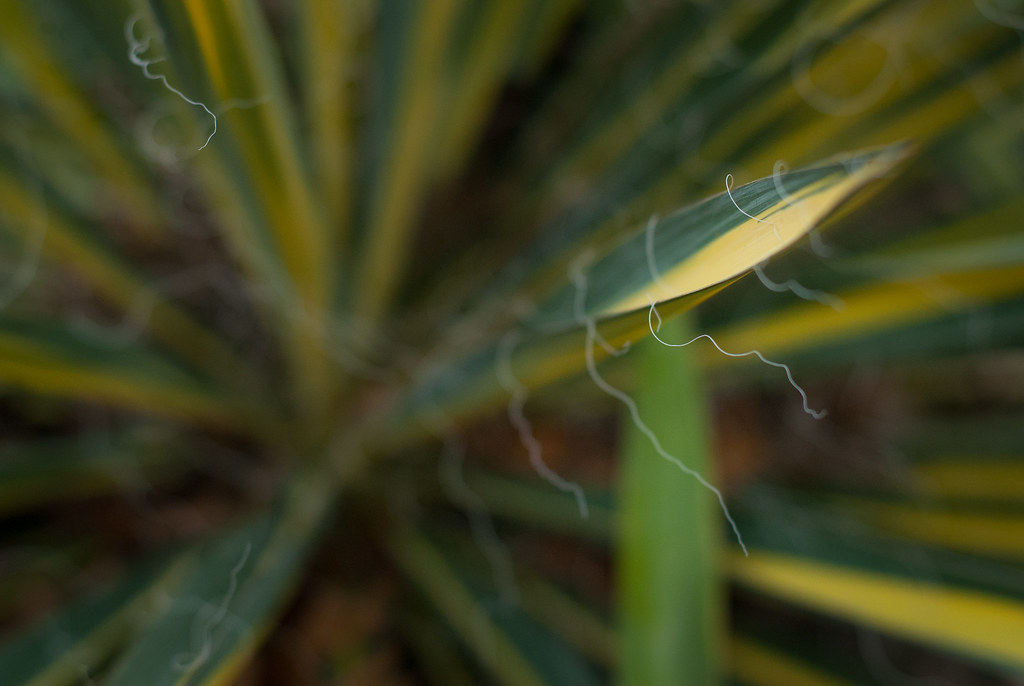
I certainly had no intention of capturing this photo when I went out on a brief walk one chilly December afternoon. My only goal was to get a picture of something, but I didn’t know what that would be. This time of year there’s a dearth of colors in nature, and on an overcast day like this one the world almost looks like it’s being displayed through a sepia filter. This splash of green caught my eye though, and when I looked closer and saw the little tendrils poking out from the side of its leaves I knew I had found my subject. The hard part, then, was figuring out how to shoot it in such a way that one of the wisps would be isolated against the rest of the plant. I ended up shooting this at f/2.8 (1.8 would have resulted in a depth of field that was simply too shallow, while f/4 or smaller would not have been able to isolate just one solitary strand like this) using manual focus, and it worked out pretty well. I don’t know anything about yucca plants, but I must say, if they can stay green through the winter then I’m already kind of sold on them.

Read my educational photography articles at Digital Photography School

Tower Sunrise

December 31, 2014 4 Comments

Tower Sunrisehttps://www.weeklyfifty.com/wp-content/uploads/2014/12/WeeklyFiftyPodcast2014December31TowerSunrise.mp3

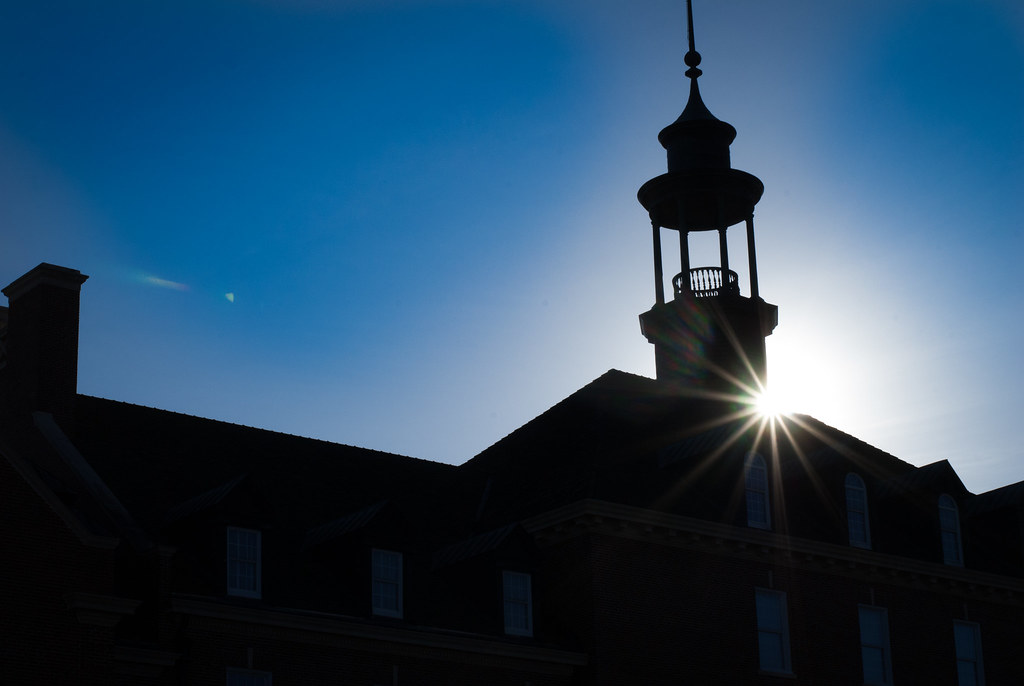
I’m not sure exactly why, but I like pictures that show star patterns around lights. A few weeks back I posted an image called Preparation, which showed some work lights with star patterns, and I have done this a few other times as well. It’s kind of a cool effect that does not require any special manipulation or trickery other than just knowing how to control your camera. To get the star patterns around any light, just stop down the aperture so it’s super duper small (I shot this at f/16, which is as tiny as my 50mm lens will go, but other lenses can go waaaay smaller). The hard part was figuring out where to stand to get the image I wanted.

Fortunately I could use the shadow of the tower to get a good idea of where to position myself. I wanted to get the sun to poke out right at the base of the tower where it meets the roof of the building, but instead of going blind by looking at the sun and trying to move myself until I was in position, I just turned around and found the ideal spot by looking at the grass. I faced backwards and walked around until the shadow of my head was right at the spot on the ground where the shadow of the tower met the roof. Then I turned back around, snapped one photo, and called it a day.

As a general rule I’m not a huge fan of altering my own images in post beyond simple color corrections. I don’t like adding or deleting elements, as it creates a false sense of reality rather than simply trying to express my vision for the image. In this case I made an exception, as the original photo was not at all what I wanted. At small apertures, especially facing a light source, all the imperfections in your lens will suddenly become visible: any dust, hair, or other particles sitting on the glass will show up plain as day. I used Lightroom’s Healing brush quite extensively to get rid of these, as well as the contrail in the middle of the sky. I also did a bit of coloring adjustments to get the sky a nice deep blue, and made the building itself a bit darker with some contrast changes. This begs the question, though: where do we draw the line when it comes to image manipulation? What is allowed and what should be forbidden? I don’t really have a good answer for that, but would certainly like to hear your thoughts in the comment section below.

Read my educational photography articles at Digital Photography School

The Meaning of Christmas

December 24, 2014 11 Comments

Tree Lightshttps://www.weeklyfifty.com/wp-content/uploads/2014/12/WeeklyFiftyPodcast2014December24TreeLights.mp3

It’s a bit tricky to get photos that represent Christmas here in Oklahoma, or at least the traditional snow-covered-evergreens, kids-skating-on-ice, carolers-singing, mug-of-cocoa-by-the-fireplace Norman Rockwell-style version that many people think of at this time of year. While it is not exactly uncommon per se to get a storybook White Christmas around here, with highs anywhere in the 30’s to 50’s throughout December it is generally more the exception than the norm. So my challenge for this week, then, became one of capturing an image that represents Christmas given the constraints, not only of geographical location but of time, that I was facing. My solution was to shoot a picture of some decorations on our Christmas tree, but soon found that it was easier said than done.

I wanted to get a picture that felt cozy and evoked a sense of warmth and comfort, and to me this was best represented by a close-up image of our Christmas tree. I wanted to shoot it in the wee hours of the morning so I could get the glow of the lights without any other ambient lighting, and even though I was pointing my camera straight at some of the little colored bulbs I still had to use a tripod since the light output is so low. A few photos later I realized that shots of just the lights were not all that interesting, so I looked for a few ornaments to more or less anchor the photo and give the viewer something on which to focus. I liked this felt tree ornament, and shot it from a low angle to give it a more commanding presence in the frame. My hope is that the first thing you notice is the tree ornament, then the lights, and then the branches of the (fake) tree around it.

Taking this photo made me think of the artificial nature of everything around us, particularly at this time of year when we give, and ask for, so many man-made things. The Lord says in Matthew 24:25 that “Heaven and earth will pass away, but my words shall never pass away.” It’s ironic that when we celebrate the birth of our savior Jesus we often do it with man-made gifts that are ultimately going to turn to rust and ashes, when in fact the true meaning of Christmas is all about a relationship with our Lord. It’s an eternal gift He gave to us that will outlast anything we can possibly have here on earth. I hope, then, that this photo is just one tiny reminder of Christmas and the real meaning behind it all.

Read my educational photography articles at Digital Photography School

  • « Go to Previous Page
  • Page 1
  • Interim pages omitted …
  • Page 119
  • Page 120
  • Page 121
  • Page 122
  • Page 123
  • Interim pages omitted …
  • Page 141
  • Go to Next Page »

Copyright © 2026 Creative Commons License
This work is licensed under a Creative Commons Attribution-NonCommercial-NoDerivs 3.0 Unported License.